[SUMMARY]
This blog page intuitively analyzes a Korean high school optics exam using reversibility of light, refraction angles, and total internal reflection.


[Question]
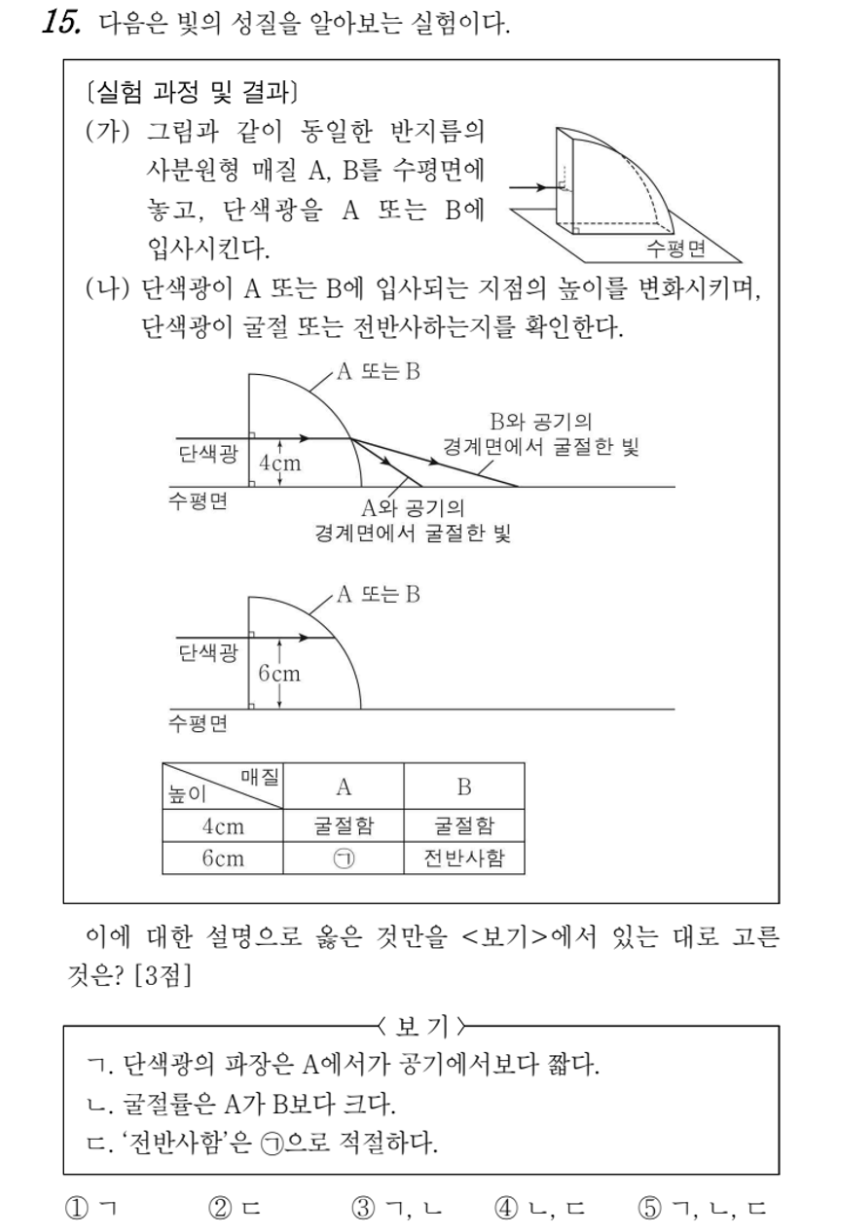
(a) As shown in the figure, quarter-circular media A and B, with the same radius, are placed on a horizontal plane, and monochromatic light is incident on either A or B.
(b) By varying the height of the point at which the monochromatic light enters A or B, it was examined whether the light underwent refraction or total internal reflection.
Based on the experimental results below, choose all the correct statements.
<Statements>
(a) In medium A, the wavelength of monochromatic light is shorter than in air.
(b) Medium A has a greater refractive index than medium B.
(c) “Total internal reflection” corresponds to (Unknown).

[Think Along]
Before solving the problem, I would like to introduce the principle of reversibility of light, which can be useful in geometrical optics problems.
[Reversibility of Light]
There is a principle known as the reversibility of light. The idea is simple: if light passes through a certain path in a given optical system, then light can also travel along the same path in the reverse direction. In other words, as shown in the figure below, if monochromatic light travels from left to right along the blue path, then light entering from the opposite side along the red path will follow exactly the same path in the reverse direction.

Now let us examine the truth or falsity of each condition one by one.
(a) In medium A, the wavelength of monochromatic light is shorter than in air.
First, (a) is true.
Looking at the red path in the figure, we see that as light enters lens A from air, it bends toward medium A. This is the typical behavior of a wave entering from a rarer medium into a denser medium. In addition, when entering a denser medium, the wavelength becomes shorter. The following figure illustrates why the direction of propagation bends when light enters a denser medium from a rarer one.

This situation of light entering from a light medium (also called a rarer medium, where light travels faster) into a dense medium (a denser medium, where light travels slower) can be compared to a car entering from a smooth cement road into a grassy field. Suppose the car is moving roughly in the direction of (x, y = 1, 1) toward (x, y = 0, 0). As it crosses the boundary, the car’s right wheel touches the grass first, while the left wheel is still on the smooth road. During that brief moment of crossing the boundary, the friction on the two wheels is different, and as a result the car veers slightly to the right. The denser the grass, the more the car will turn.
Next, let us examine condition (ㄴ).
(b) Medium A has a greater refractive index than medium B.
To solve the problem, we need to determine which of the two lenses, A or B, is denser (i.e., has a greater refractive index).

When light enters a lens from air, the degree to which its direction bends is proportional to the refractive index. Therefore, lens A has a greater refractive index than lens B.
Thus, condition (b) is true.
Finally, let us look at condition (c).
(c) “Total internal reflection” corresponds to (Unknown).
The condition “6 cm” means that the angle at which light enters from left to right is the same for both lens A and lens B. Therefore, what we must determine is this: when light enters the boundary between the lens and the air at the same angle, and total internal reflection occurred in lens B, can we also expect total internal reflection in lens A? This is the question to be answered.
Now look at the following figure.

The blue path shows light passing through the lens and exiting into the air. But which case looks more difficult for the light to break through the boundary—A or B? Lens A looks more difficult. (Here, if we express “difficult” in scientific terms: “Since A has a greater refractive index, light finds it harder to escape the boundary, making total internal reflection more likely.” However, since our goal is to solve physics problems quickly and intuitively, it is often more useful to develop the ability to judge such situations in terms of “easy” or “difficult” rather than strictly formal descriptions.)
Therefore, if at the same incident angle light in B could not penetrate the boundary and underwent total internal reflection, then in A it would certainly undergo total internal reflection as well. Hence, condition (c) is true.
Since (a), (b), and (c) are all true, the correct answer is option 5.
[Epilogue] Up to now, I’ve tackled three optics problems, and coincidentally, all of them worked out neatly with the car-on-grass analogy and the principle of the reversibility of light. I wonder what other kinds of problems might come along next.
[Source: May 2025 Korean National Physics I Exam, Grade 12, Problem 15]
'2025 Exams > May' 카테고리의 다른 글
| Constant Force Friction? (1) | 2025.08.24 |
|---|