[SUMMARY]
This blog page intuitively applies uniform acceleration, non-dimensionalization of speeds/time, velocity graphs, and momentum conservation to solve a Korean high school mechanics exam.


[Problem]
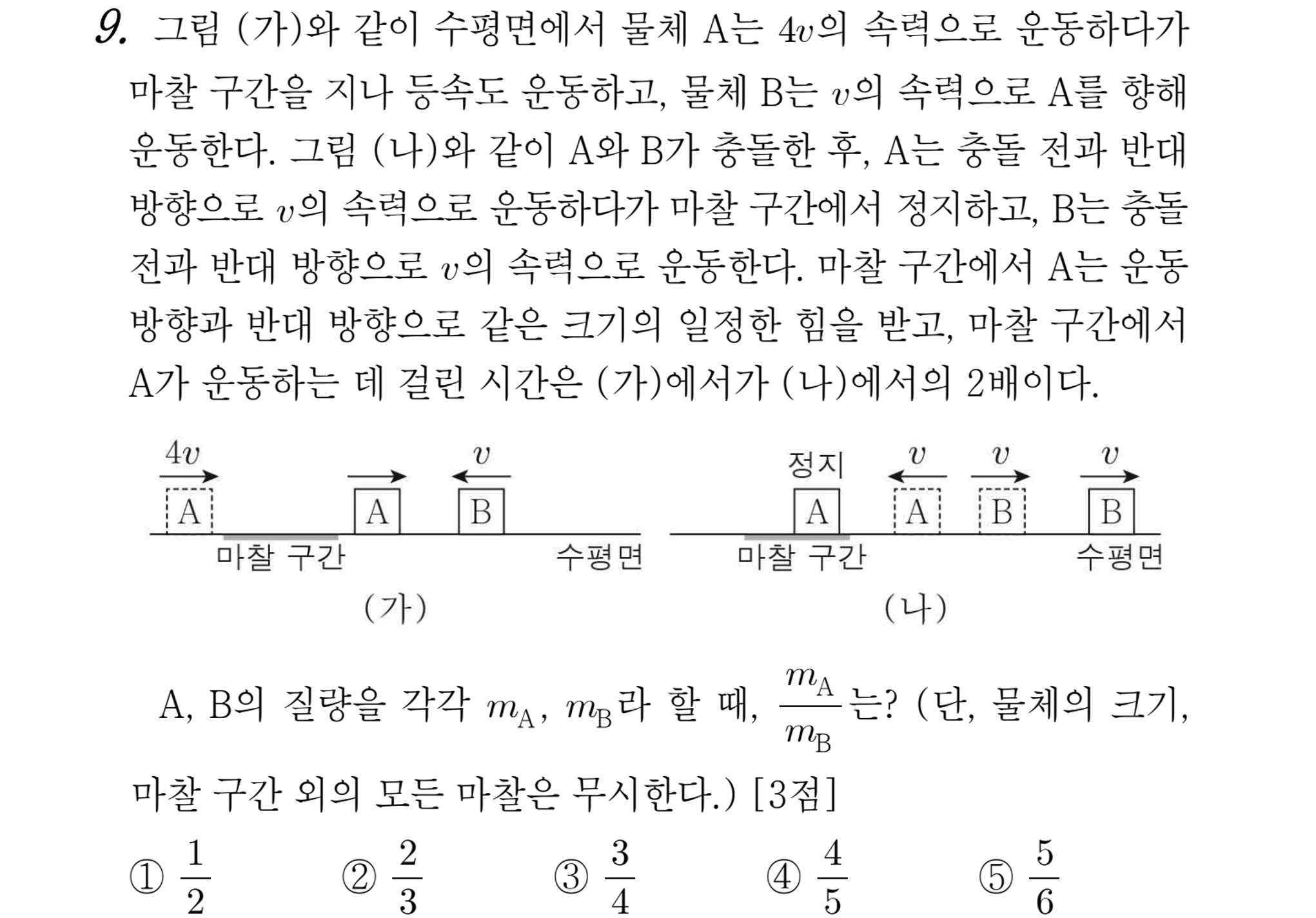
As shown in figure (a), object A moves on a horizontal plane with speed 4v. After passing through a friction zone, it continues with uniform motion. Object B moves toward A with speed v.
As shown in figure (b), after A and B collide, object A moves in the opposite direction to before the collision with speed v and then stops in the friction zone. Object B also moves in the opposite direction to before the collision with speed v.
In the friction zone, object A experiences a constant force opposite to its direction of motion. The time it takes for A to move through the friction zone in case (a) is twice that in case (b).
If the masses of A and B are m_A and m_B respectively, what is the ratio m_A/m_B?

[Think Along]
In this problem, there is a unique expression:
“An object receives a constant force of the same magnitude in the direction opposite to its motion while in the friction zone.”
This wording is actually a trick intended to mislead test takers. Instead of simply saying “a slope,” the problem deliberately uses the term “friction zone” to cause confusion. While an object moves uphill, it receives a constant force. Remember F=ma. If we know the initial velocity and the acceleration at every moment, we can predict the object’s motion at every moment. Whether it is a friction zone or a slope, F=ma makes no distinction.
Now, let’s look at the following figure.
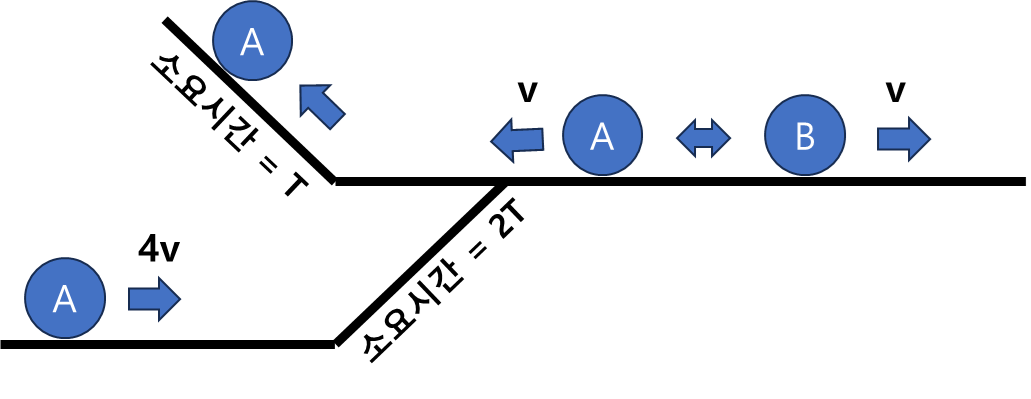
The first friction zone can be expressed as follows:
Initial velocity = 4v
Time taken = 2T
Acceleration = -a
Meanwhile, the second friction zone is as follows:
Initial velocity = v
Time taken = T
Acceleration = -a
[Non-dimensionalization]
Now we need to decide on non-dimensionalization. In this problem, nothing is given in absolute quantities—whether mass, initial velocity, or time. Therefore, it is better to arbitrarily set some convenient values and proceed. The following shows the result after applying non-dimensionalization:
First friction zone: Initial velocity = 4 m/s, Time taken = 2 s, Acceleration = -1 m/s²
Second friction zone: Initial velocity = 1 m/s, Time taken = 1 s, Acceleration = -1 m/s²
Next, let’s look at the 1, 3, 5, 7 rule of uniformly accelerated motion.
[Regularity of uniformly accelerated motion]
Uniformly accelerated motion might seem very complicated moment by moment, but in fact, it has an amazing consistency. We may call this the 1, 3, 5, 7, 9 rule. Remember it well. In any uniformly accelerated motion, suppose an object starts from rest, and the distance traveled in the first time interval t is L. Then, in the next time interval t, the distance traveled is 3L, in the following t it is 5L, and in the next it is 7L. Of course, after that it continues with 9, 11, 13… and so on.

In the figure, the horizontal axis represents time and the vertical axis represents velocity. Since the motion is uniformly accelerated, the velocity increases linearly with time. In each diagram, the red lines are equally spaced, meaning the uniformly accelerated motion has been divided into equal time intervals of length t. The area of the blue shapes cut by the red lines represents the distance traveled.
In the left diagram, t is relatively large. The distance traveled in the first interval (area) is one triangle, and in the second interval the distance traveled is three triangles… showing that the 1, 3, 5, 7 rule is being followed well.
In the middle diagram, t has been made smaller. However, the rule of one triangle, three triangles, five triangles is still satisfied.
In the right diagram, the triangles are distorted. You may have noticed that the slope of the triangles in the figure represents the magnitude of the acceleration. Even though the acceleration has changed in this way, the distance traveled in the first interval is still one triangle, in the second interval three triangles, then five, then seven… showing that the 1, 3, 5, 7 rule is being maintained very well.
Now, let’s connect the 1, 3, 5, 7 rule of uniformly accelerated motion with this problem.
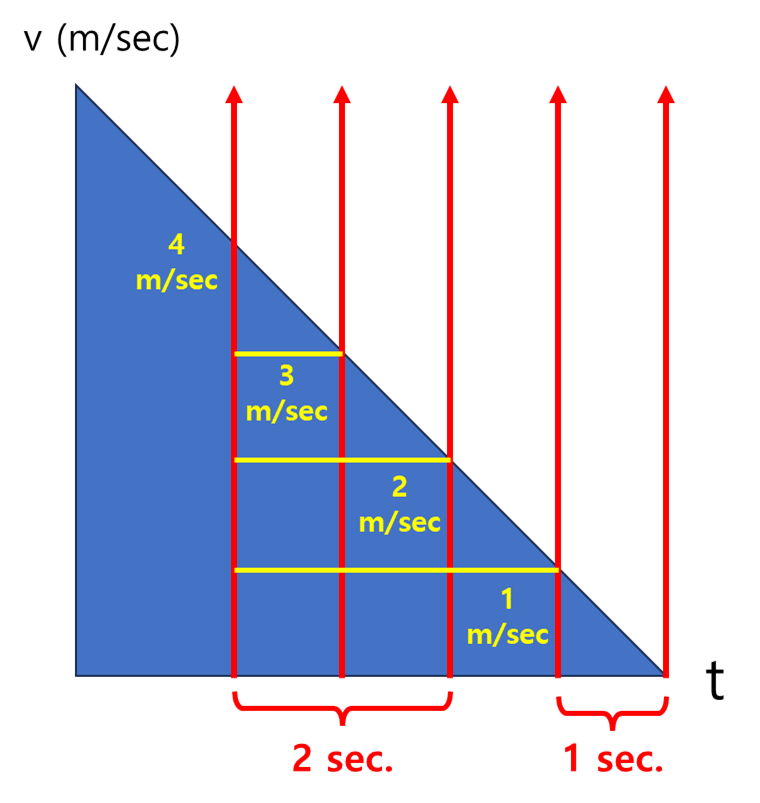
The figure is a time–velocity graph. Since the units of both the horizontal and vertical axes are 1, the acceleration is -1.
For object A on the first uphill section, its initial velocity is 4 and the time is 2 seconds. From the area of the “2 sec.” section in the graph, we can immediately see that the distance traveled is 6 m.
For object A on the second uphill section, by reading the area of the “1 sec.” section in the graph, we can immediately see that the distance traveled is 0.5 m.
However, the distance traveled is not actually useful for finding the answer.
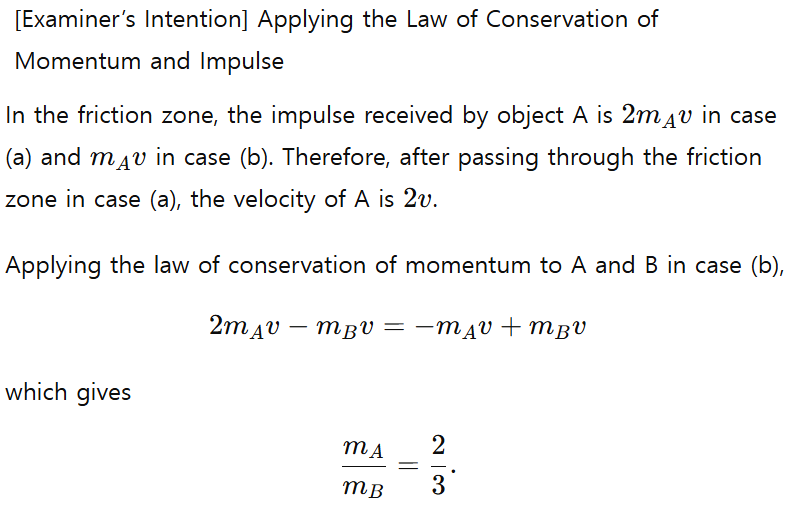
What matters is that at the end of the “2 sec.” section, A’s velocity is 2 m/s. That is, right before colliding with B after climbing the hill, A’s velocity was 2v, and immediately after the collision it became -v. So now we know both A’s velocity just before and just after the collision.
Let’s apply the law of conservation of momentum: (Velocity to the Left = Negative Velocity)
Total momentum before collision = 2m_A - m_B
Total momentum after collision = -m_A + m_B
Calculating,
2m_A - m_B = -m_A + m_B
3m_A = 2m_B
m_A / m_B = 2/3
Therefore, the answer is choice 2.

[Examiner's Note]

[Source: May 2025 Korean National Physics I Exam, Grade 12, Problem 9]
'2025 Exams > May' 카테고리의 다른 글
| Light Entering a Quarter-Pie Lens (0) | 2025.08.24 |
|---|