[SUMMARY]
This blog page intuitively uses light refraction, car-analogy, triangle symmetry, reversibility of rays, and simple geometry to solve a Korean high-school optics exam.

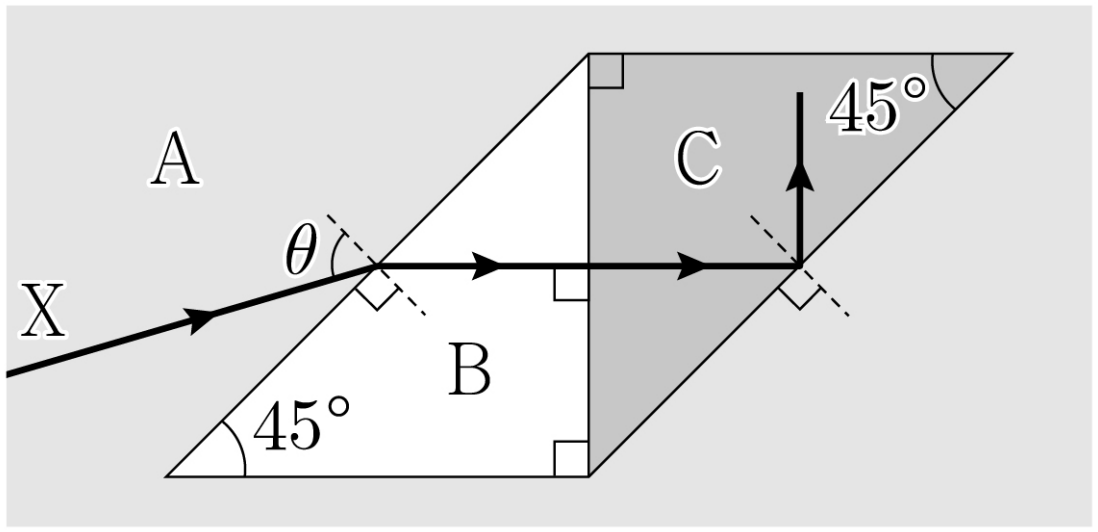
<Problem>
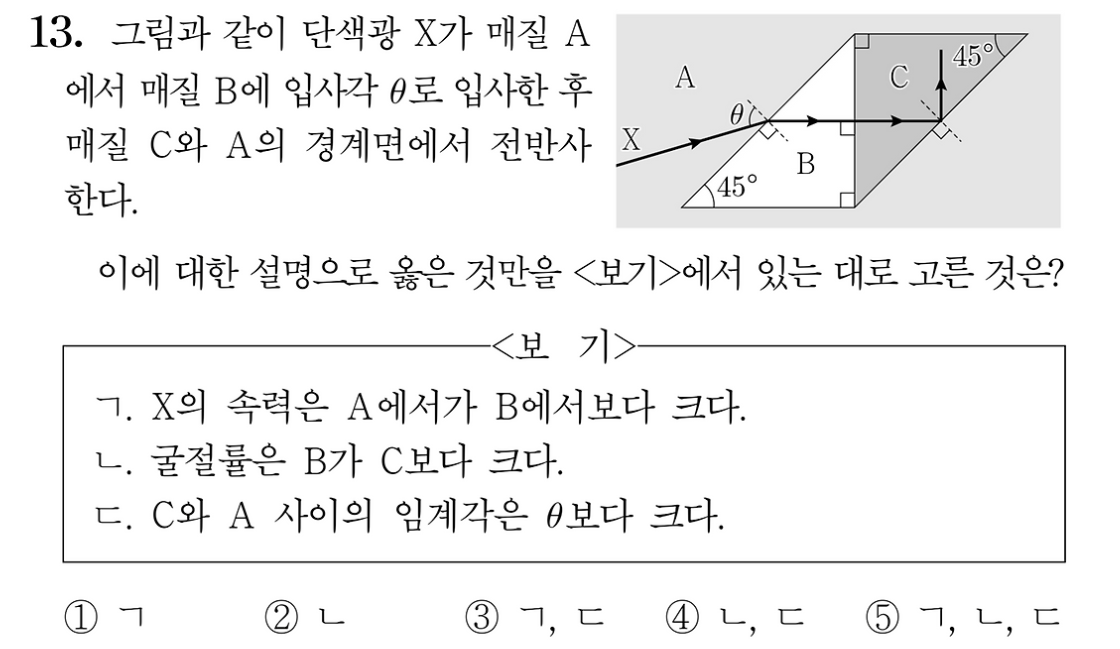
As shown in the figure, monochromatic light X enters medium B from medium A with an angle of incidence θ, and then undergoes total internal reflection at the boundary between medium C and medium A. Which of the following statements is correct?
<Options>
a. The speed of X in A is greater than in B.
b. The refractive index of B is greater than that of C.
c. The critical angle between C and A is greater than θ.
<Choices>
① a ② b ③ a, c ④ b, c ⑤ a, b, c
[Think Along]
Let’s first look at the big picture. In the center, there are two triangles back-to-back, and they happen to form the shape of a square cut in half. Each triangle has angles of 90°, 45°, and 45°. With this overall structure in mind, it’s time to move on to solving the problem.
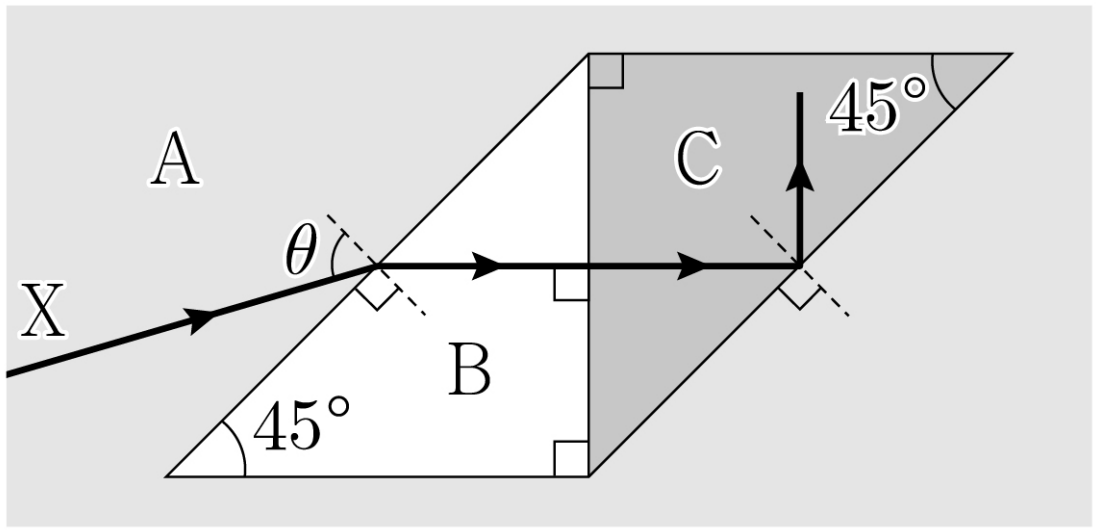
First, (a).
a. The speed of X in A is greater than in B.
From the way the light bends at the A/B boundary, (a) is true. It’s as if the light gets “slowed down” or “hindered” as it enters B from A. You can compare the situation—light entering from a rare (low-density; light travels faster) medium into a dense (high-density; light travels slower) medium—to the following picture: a car is coming roughly from the (x, y) = (1, 1) direction toward (x, y) = (0, 0). As it crosses from a smooth concrete surface into a grassy field, the right wheel hits the grass first while the left wheel is still on the smooth surface. For a brief moment while crossing the boundary, the friction on the left and right wheels is different, so the car veers slightly to the right. The denser the grass, the more it will turn.

Enough small talk—back to the problem.
Let’s look at condition (b).
b. The refractive index of B is greater than that of C.
We’re asked to compare which of the two triangles is “denser” (i.e., optically tougher). To check this condition, we need a bit of imagination. Look at the following figure.
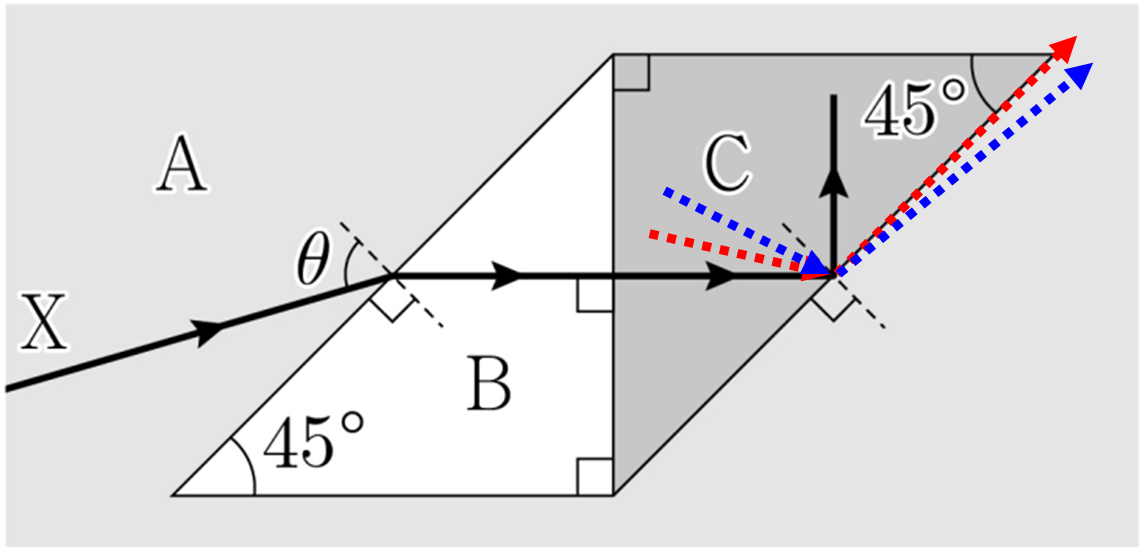
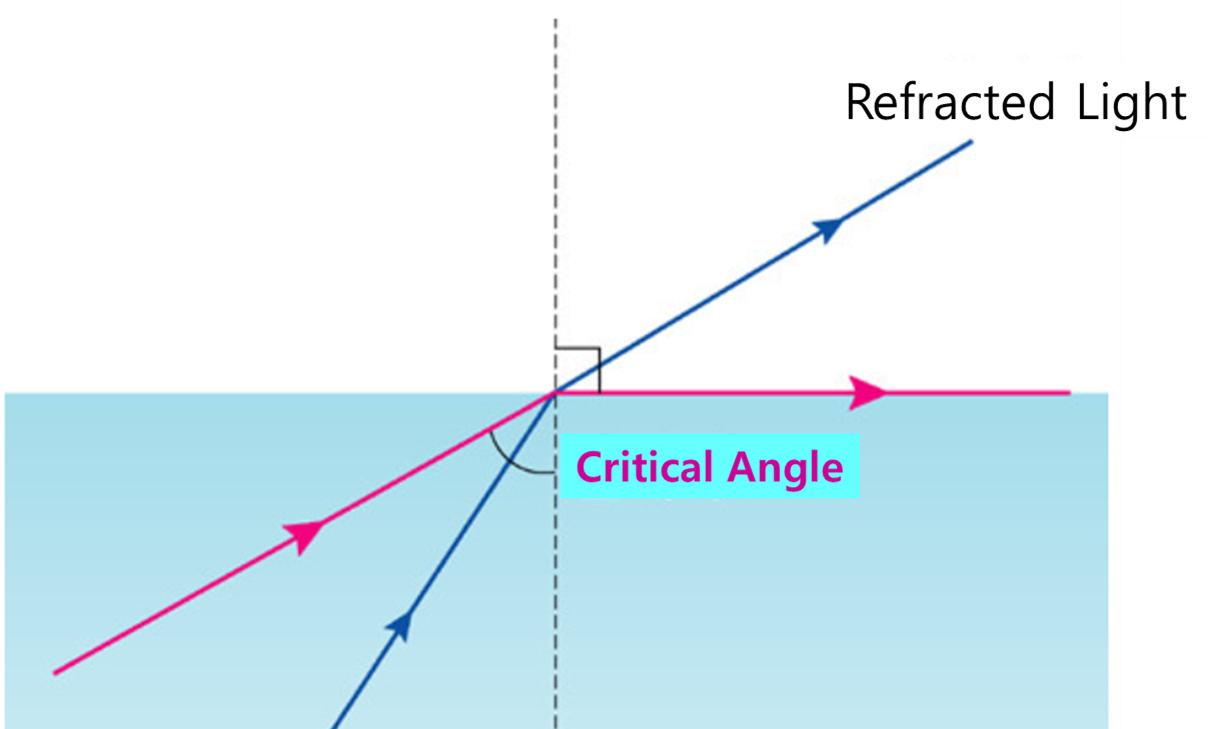
At first, the path of X passed through A and B, then entered the boundary between C and A at an incident angle of 45°. But it couldn’t break through the boundary—instead, it bounced back by total internal reflection. To break through the boundary, the incident angle would have to be sharper with respect to the surface. Apparently, it wasn’t sharp enough yet. The light just skimmed along the boundary without entering medium A. But with just a slightly sharper angle, it could pierce through… and in the end, the blue ray managed it. By making the angle just a bit sharper, it was able to slip through the boundary, just barely.
Now, I need to talk about the symmetry of optical systems. The physical laws of light remain valid even if the direction is reversed. In other words, if light travels along a certain path in an optical system, then it can also travel along the exact same path in the opposite direction. This principle is extremely useful when solving optics problems, and in geometrical optics it is called the principle of reversibility of light rays.
The following figure shows the previous diagram with the principle of reversibility applied.

On the path where the blue ray enters from A into C, its incident angle is such that it grazes along the slanted side of the right-hand triangle. Looking at the figure, you can see that the blue ray entering from A into C bends more than 45° relative to the boundary. In other words, for all angles of entry from A into C, the light bends more than 45°. Meanwhile, in the case of the black path X, the entry from A into B bent at 45° relative to the boundary. Therefore, since A→C bends more than A→B, we can conclude that the refractive index satisfies C > B, meaning condition (b) is false.
b. The refractive index of B is greater than that of C.
Finally, let’s examine condition (c).
c. The critical angle between C and A is greater than θ.
This one can be checked almost instantly just by looking carefully at the last diagram.
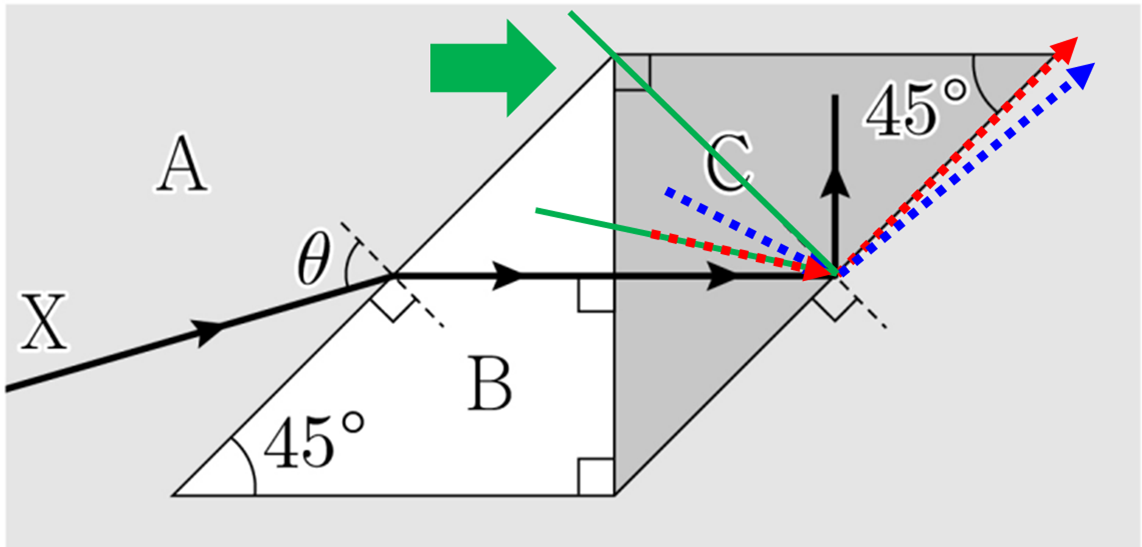
In the figure, the critical angle is clearly less than 45°, while θ is greater than 45°. Therefore, condition (c) is false.
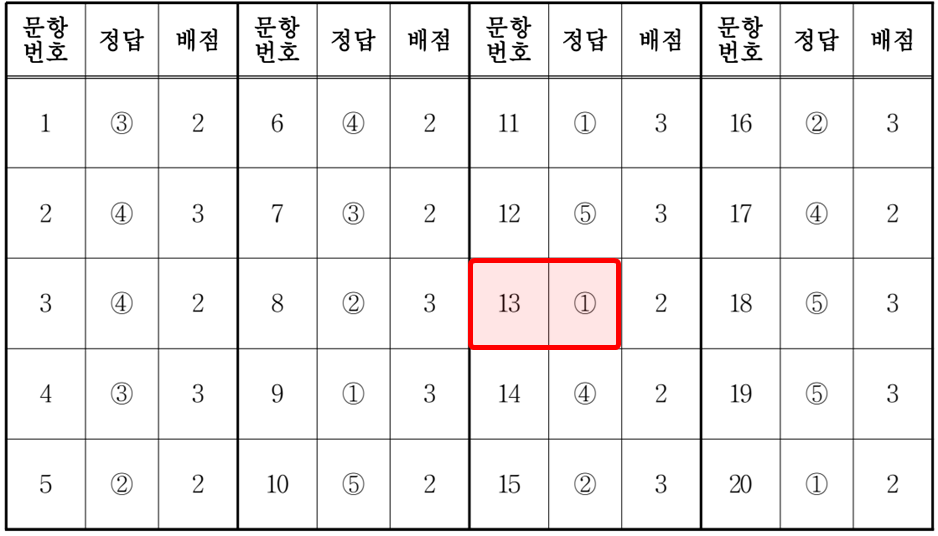
In conclusion, the correct answer is choice 1.
[Reference] Definition of the Critical Angle
[Source: June 2025 Korean National Physics I Exam, Grade 12, Problem 13]
'2025 Exams > June' 카테고리의 다른 글
| A killer problem - easier tried than left unsolved (0) | 2025.08.23 |
|---|---|
| Travelling the Same Distance in Different Times (0) | 2025.08.23 |
| Understanding Wave Motion at 0.75 Hz (0) | 2025.08.23 |