[SUMMARY]
This blog page intuitively applies uniform acceleration, time-triangle area analysis, non-dimensionalization, energy change comparison, and F=ma to solve a Korean high-school mechanics exam.

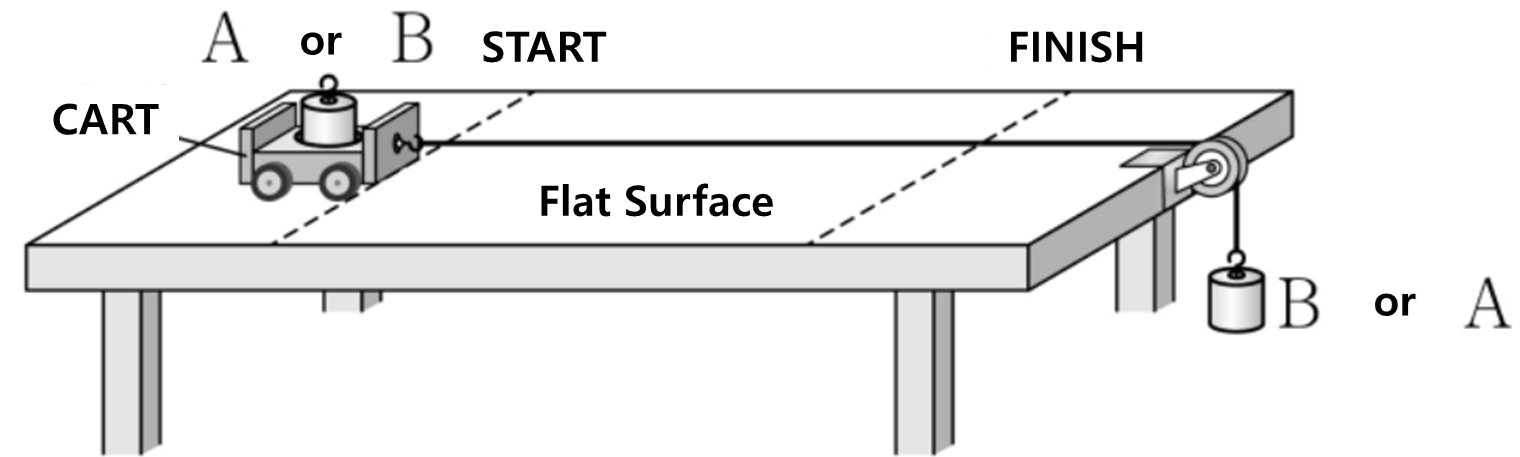
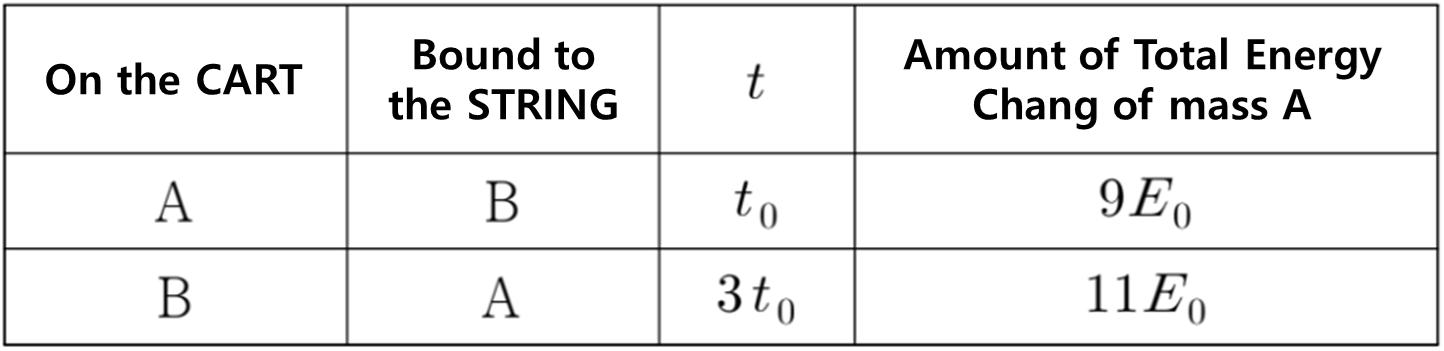
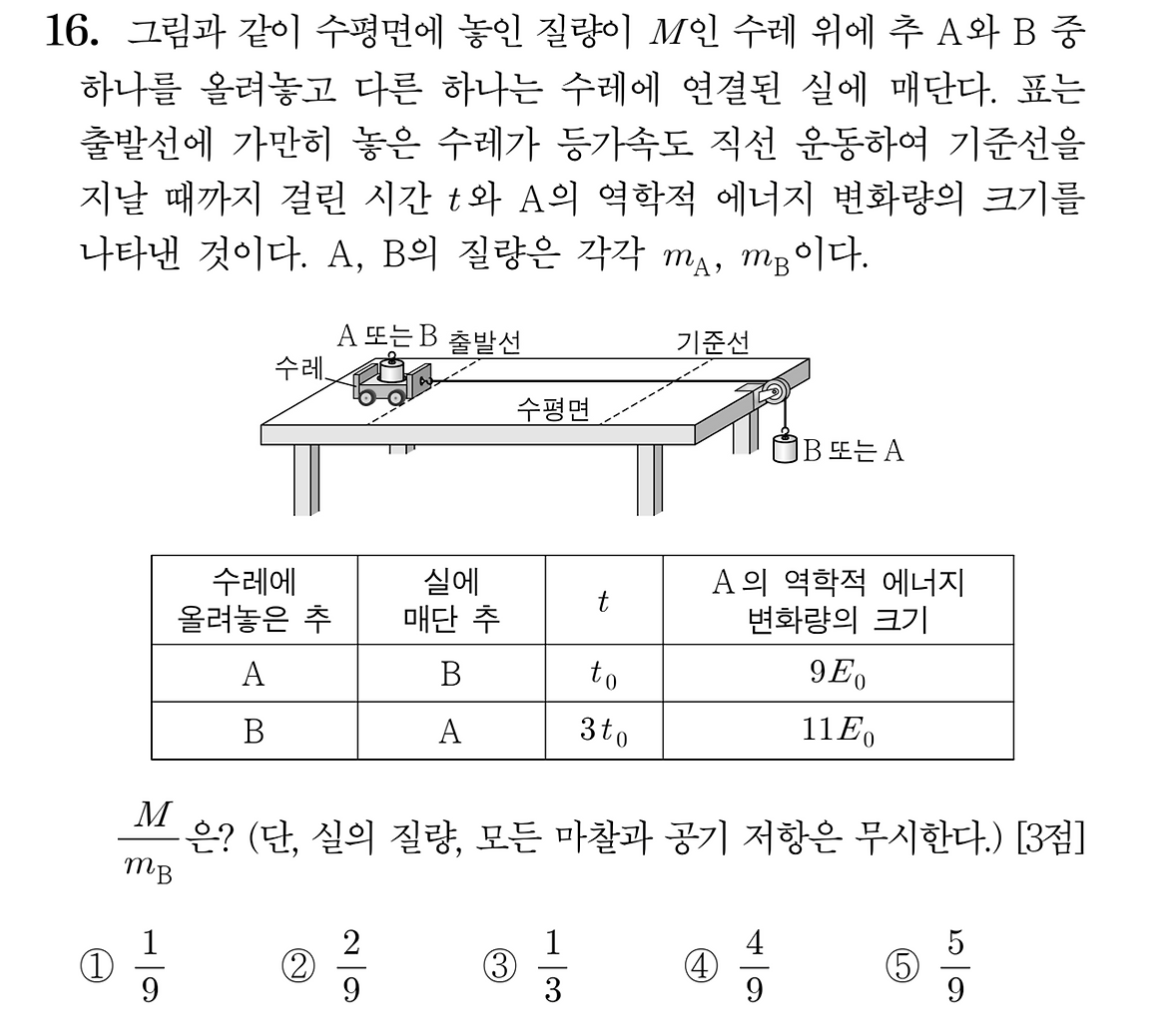
<Problem> As shown in the figure, on a cart of mass M placed on a horizontal plane, one of the two weights A and B is placed on top of the cart, and the other is hung from a string connected to the cart. The table shows the time t it takes for the cart, initially at rest on the starting line, to move with uniform acceleration and pass the reference line, as well as the magnitude of the change in the mechanical energy of A. The masses of A and B are m_A and m_B, respectively. What is the value of M/m_B? (Assume the string has no mass, and ignore all friction and air resistance.)
<Choices>
① 1/9 ② 2/9 ③ 1/3 ④ 4/9 ⑤ 5/9
<Think Along> When a problem involves constant acceleration motion of multiple masses connected by a pulley, recall F = ma. Before solving the problem directly, let’s do a simple thought experiment. The key is to determine sensibly what constitutes F and what constitutes m, considering how the objects and the string are connected. For practice, let’s look at the following figure.

We will apply F = ma to the figure above.
But before that, let’s test our intuition. In the left figure, do you see a 97 kg washing machine placed on a 2 kg cart? A very strong but massless string passes over a pulley and is connected to a 1 kg milk pack. In the right figure, the positions of the milk pack and the washing machine are reversed.
In either case, it is clear that the cart will move from the starting line to the reference line. And doesn’t it also seem obvious that the cart will move much faster in the right-hand case? That’s excellent intuition. But that alone won’t fully solve the problem.
Let’s look at the next figure.
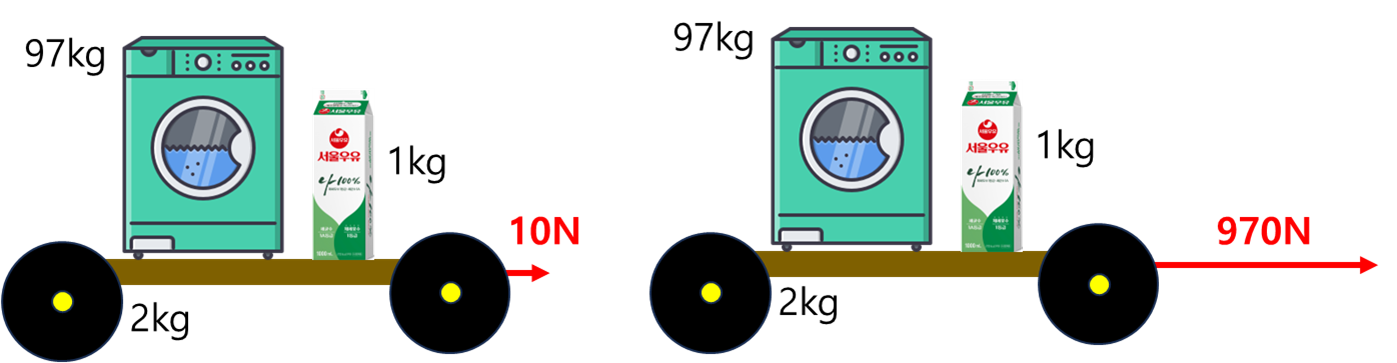
Do you feel how much simpler this new setup is compared to the earlier figure with pulleys, strings, and so on?
Now, focus on the horizontal motion of the object B (the milk pack or the washing machine) in the middle. Compare the earlier figure with pulleys and strings to this new figure, and you can sense how much simpler the new one is. Do you like it better now? Let’s apply F = ma here.
[Left figure]
F = 10 N
m = (97 + 2 + 1) = 100 kg
a = 0.1 m/s²
[Right figure]
F = 970 N
m = 100 kg
a = 9.7 m/s²
As a result, by adding physics to our intuition, we can quantitatively predict the motion of the given system. Another thing we discovered: when we swapped the washing machine and the milk pack in the setup, the acceleration of the uniform motion turned out to be proportional to the mass of the object hanging by the pulley. This fact will later be useful for solving problems.
And one more note: from a student’s perspective, redrawing the figures like this every time is not ideal. To solve exam problems within the time limit, you need to practice looking at the given figure and directly building F = ma.
Practice is over now. Let’s solve the problem.

Looking at the t column in the table, it says that the time ratio between hanging A and hanging B was 1:3, for moving the distance from the starting line to the reference line with uniform acceleration.

Since the same distance was traveled, the areas of the two triangles are equal.
Because the time ratio is 1:3, the ratio of the base lengths of the triangles is 1:3.
But note: as the horizontal axis becomes three times longer while the area must remain the same, the height also becomes 1/3.
For the faster motion, it took time t0, and the acceleration is 1/1 = 1.
For the slower motion, it took 3 t0, and the acceleration is 0.333/3 = 1/9.
Earlier we said that in this system the ratio of accelerations matches the ratio of the masses of the weights hung on the string. So the ratio of m_A to m_B must be 9:1 or 1:9. Looking at the table, it is clear that B is heavier, so m_A : m_B = 1:9.
At this point, let’s begin solving the problem step by step.
The value we need to calculate is M/m_B.
A bit of frustration begins to creep in—another ratio again…
But wait, this actually means there isn’t a single unique solution that satisfies the conditions, but rather several possible ones, and yet the ratio M/m_B will always be the same.
Oh? Is this actually convenient?
Yes. For this problem, we can simply set m_A = 1 kg and m_B = 9 kg and proceed.
Another thing: the problem does not mention the distance between the starting line and the reference line. Turning this around, it means that even if the distance between the starting line and the reference line changes, as long as the given conditions are satisfied, the mass ratio of B to the cart will remain constant. Since I like the number 1, I will set the distance between the starting line and the reference line to 1 m and proceed with the solution. Finally, let’s also take the gravitational acceleration to be 1 m/s² for convenience.
In classical mechanics problems—especially like this one, where the goal is to find a ratio of masses (a dimensionless quantity)—nondimensionalizing the main variables can simplify the solution process. Doing less nondimensionalization is harmless, though it can make the algebra heavier with more variables. Doing too much nondimensionalization, however, is risky—it can cause the answer to disappear. It is important to develop the skill of carefully judging which quantities can be nondimensionalized and which should not.
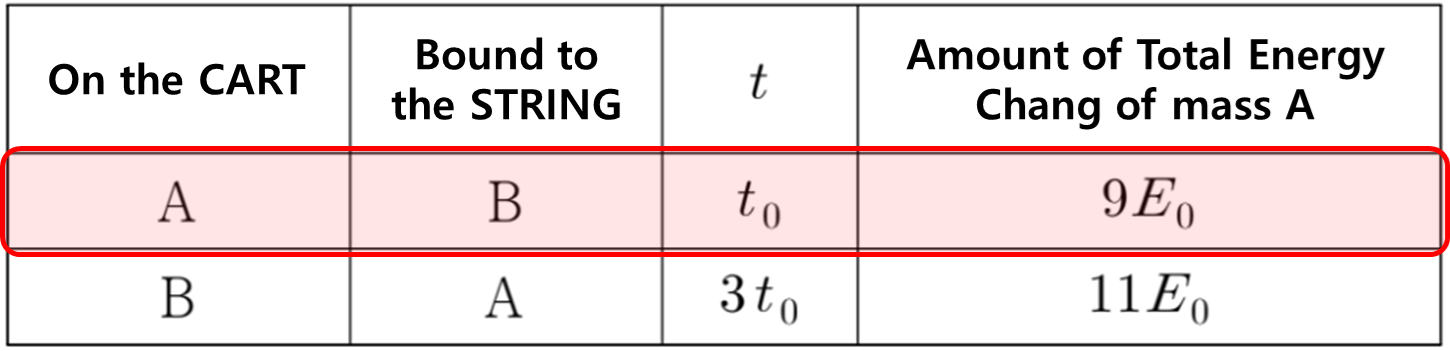
Now let’s consider the change in the mechanical energy of A in [Experiment-1: A on the cart, B bound to the string on the right].
A starts from rest, then undergoes uniformly accelerated motion, moving 1 m. Since it moves horizontally, there is no change in potential energy—only an increase in kinetic energy. Therefore, A’s final kinetic energy equals the change in its mechanical energy. Let’s calculate A’s final kinetic energy.
Final kinetic energy = Force on A × Distance moved
Force on A = Acceleration of A × 1 kg
Acceleration of A = Acceleration of the whole system (A, B, and the cart)
F = m_B × g = 9 = ma = (1 + 9 + M) × Acceleration of A
Final kinetic energy = 9 / (M + 10)
Change in mechanical energy of A (Experiment 1) = 9 / (M + 10)
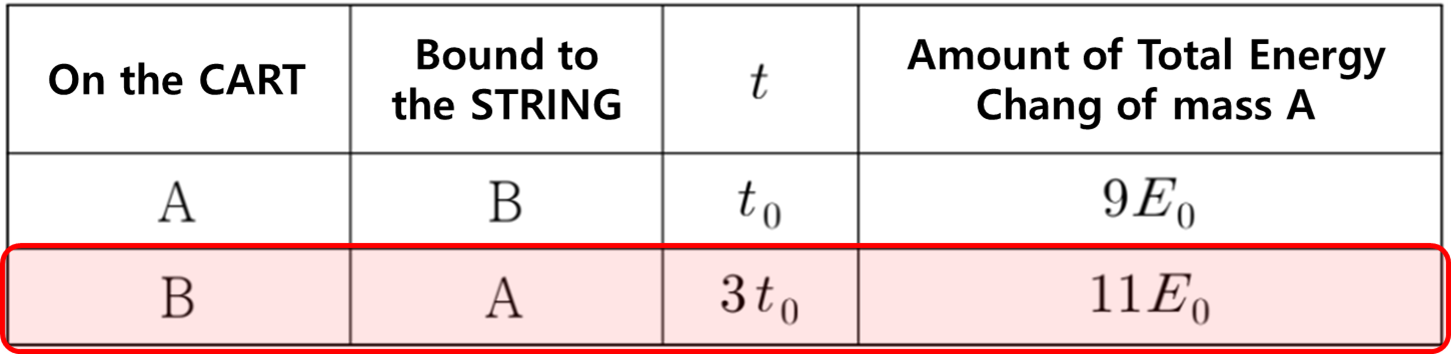
[Experiment-2] is a little more complicated. Here, A acts as the hanging weight. The decrease in A’s potential energy is what accelerates A, B, and the cart. The decrease in A’s potential energy is distributed into the kinetic energies of A, B, and the cart according to their mass ratios. Therefore, the change in A’s mechanical energy is as follows:
Change in mechanical energy of A = Decrease in A’s potential energy – A’s final kinetic energy
Change in mechanical energy of A (Experiment 2) = 1 × 1 × 1 – 1/(M+10) = 1 – 1/(M+10) = (M+9)/(M+10)
(Kinetic energy is proportional to the square of velocity for the same mass. Earlier we said that the final velocity in Experiment 1 was 3 times faster than in Experiment 2.)
Now it is time to apply the last condition of the problem: the ratio of A’s change in mechanical energy between the two experiments is 9:11.
9:11 = 9/(M+10) : (M+9)/(M+10)
9:11 = 9 : (M+9)
99 = 9M + 81
9M = 18
M = 2
M/m_B = 2/9
Therefore, the answer is choice ②.

[Source: June 2025 Korean National Physics I Exam, Grade 12, Problem 16]
'2025 Exams > June' 카테고리의 다른 글
| A killer problem - easier tried than left unsolved (0) | 2025.08.23 |
|---|---|
| Understanding Wave Motion at 0.75 Hz (0) | 2025.08.23 |
| Estimating the critical angles using pencil and ruler (0) | 2025.08.23 |