[SUMMARY]
This blog post intuitively uses action–reaction, non-dimensionalization of masses and speeds, energy partitioning, and height–energy relations to crack a Korean high-school mechanics exam.

<Problem>
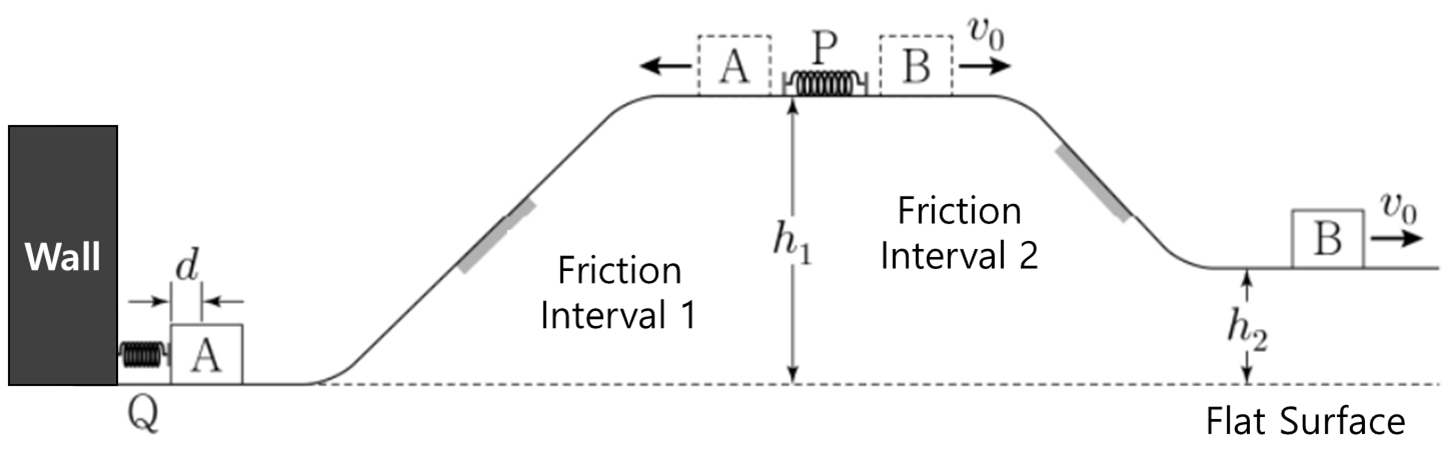
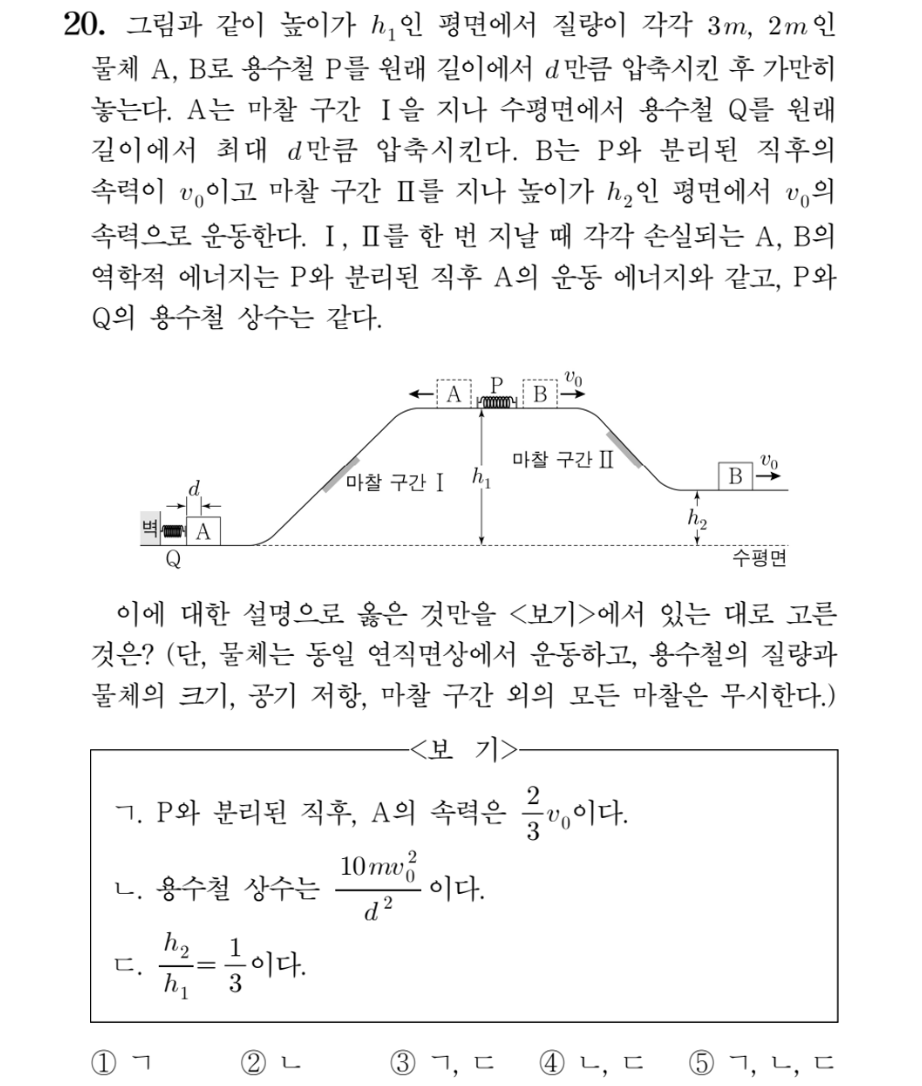
As shown in the figure, on a plane of height h1, objects A and B of masses 3m and 2m, respectively, compress spring P by a distance d from its natural length and are then released from rest.
Object A passes through frictional Interval 1 and on the horizontal plane compresses spring Q by at most d from its natural length.
Object B, immediately after separating from spring P, has speed v0. After passing through frictional Interval 2, it moves on a plane of height h2 with the same speed v0.
The mechanical energy lost by A and B when each passes once through Interval 1 and Interval 2, respectively, is equal to the kinetic energy of A immediately after separating from spring P. The spring constants of P and Q are the same.
Which of the following statements are correct?
(Assume the objects move in the same vertical plane, and neglect the mass and size of the springs, air resistance, and all friction except in the specified intervals.)
<Statements>
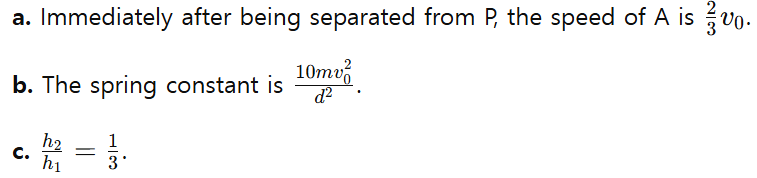
<Choices>
① a ② b ③ a,c ④ b,c ⑤ a,b,c
[Think Along]
This problem looks like a killer question, but it is not actually one. It can be solved step by step using the initial conditions.
The tricky part is correctly interpreting what happens at time t₀. We have two objects of different masses at rest, with a spring placed between them pushing them apart. How should we interpret this situation?
[Spirit] Although a spring is somewhat prickly and sharp, in this problem let us imagine it as an invisible spirit that cannot be seen or touched. That makes the thinking easier. This spirit pushes A and B apart from the middle. The spirit has no mass—only force. To an outside observer, it looks like A is pushing B and B is pushing A.
It’s like an astronaut in empty outer space pushing against a huge metal object. The metal object is obviously far heavier than the astronaut, so the one that actually moves back is the astronaut. If the astronaut had the exact same mass as the metal object, then both would recoil with the same speed.
Up to this point, it’s all in the realm of intuition. The real question is: how can we quantify this situation? That is the dividing line between being able to solve this problem or not.
![An Astraunaut pushing against a spaceship [chatGPT]](https://blog.kakaocdn.net/dna/bfXXJH/btsPTRz2xjI/AAAAAAAAAAAAAAAAAAAAAI7Yp-5uaa2pgjusKawVleY6H7w7FDGTKMLOOFN_90kC/img.png?credential=yqXZFxpELC7KVnFOS48ylbz2pIh7yKj8&expires=1780239599&allow_ip=&allow_referer=&signature=0DuB%2BvflGCDg6qFrdzBNE4sy9TM%3D)
[Action–Reaction Between Two Masses]
This problem can be solved either by applying conservation of momentum or by applying action–reaction. Since I always prefer F = ma, I will solve it using action–reaction.
Let’s apply action–reaction. This requires a bit of imagination. As long as the spring is simultaneously in contact with both A and B, A can push B, and B can push A. At every instant during which the spring touches both A and B, the force exerted by A on B and the force exerted by B on A are equal.
Because acceleration is inversely proportional to mass, the ratio of the accelerations caused by this action–reaction force is always 2:3. If the acceleration ratio is 2:3 at every moment, then the velocity ratio will also be 2:3 at every moment. Likewise, the displacement ratio will be 2:3, although displacement is not particularly important in solving this problem. The conclusion we can draw here is:
v_A : v_B = 2 : 3 (the velocities of A and B at the instant they are pushed apart by the spring).
[Non-dimensionalization]
Now it’s time to decide on a non-dimensionalization scheme. In this problem, nothing is given in absolute values—not the masses, nor the initial velocity, nor the height. Therefore, it is better in many ways to assign convenient arbitrary values at the start.
Let’s set the initial velocities of the two objects as follows:
v_A = 2 m/s
v_B = 3 m/s
Since the masses are given in the ratio 3:2, we might as well set them as follows. Instead of 3 kg and 2 kg, I will use 30 kg and 20 kg; I will explain later why I chose the larger values.
m_A = 30 kg
m_B = 20 kg
Now, it is time to calculate the initial kinetic energy:
E_A0 = 0.5 × 30 × 4 = 60 J
E_B0 = 0.5 × 20 × 9 = 90 J
E_0 = E_A0 + E_B0 = 150 J
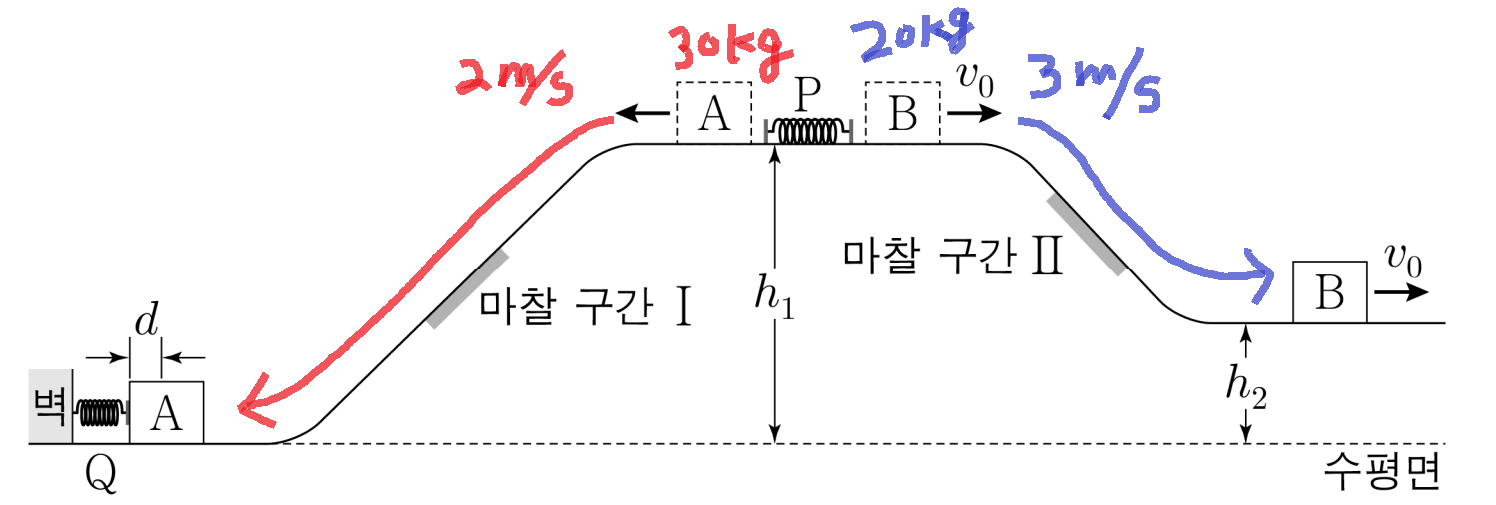
Object A came down the slope, compressed the spring by distance d, and then stopped. At the moment it stopped, all of the kinetic energy that A had was stored in the spring. The problem states that all the springs involved are identical.
Now, let’s go back to the initial “big bang” moment. At that time, both objects A and B were at rest, and all the energy was stored in the spring. That energy was converted without any loss into the kinetic energy of A and B, totaling 150 J.
Therefore, when A comes down the slope and compresses the spring at the bottom by distance d, the energy stored in that spring must also be 150 J. Since it is the same type of spring and it is compressed by the same amount d, the energy stored must be the same.
E_S = 150J
[Clue 1] Immediately after B separated from A, its speed was v0 (= v_B = 3 m/s), and after passing through the frictional interval it moved at constant speed v0 (= v_B = 3 m/s) on the plane at height h2.
B initially had 90 J of kinetic energy, and after coming down the slope it still had 90 J of kinetic energy. In other words, the potential energy that B lost while descending the slope must have been completely dissipated by the frictional interval.
[Clue 2] The mechanical energy lost when passing through Intervals 1 and 2 is equal to the kinetic energy of A immediately after separating from P (= E_A0 = 60 J).
[Conclusion] Now it is time to gather all the pieces of information we have collected and determine which of the given statements are correct.
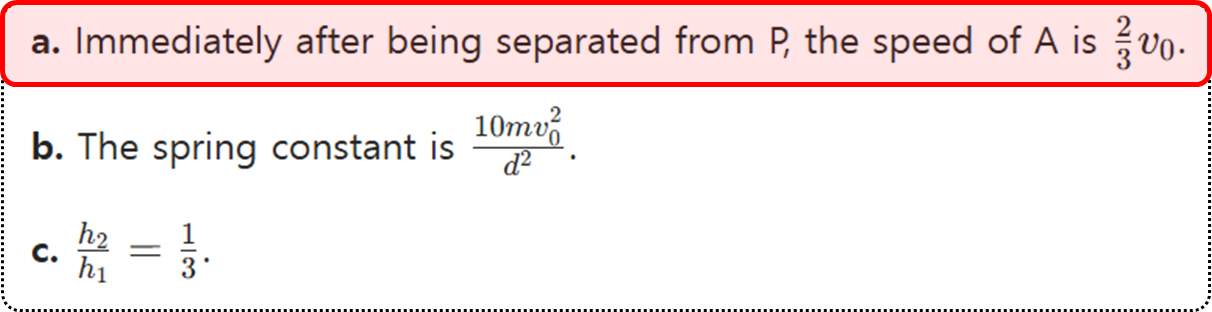
First, let’s look at (a).
Immediately after separating from P, the speed of A is 2 m/s, which is equal to 0.666 × (v_B = 3 m/s). This is correct.

Next, let’s look at (b).
We need to determine the spring constant.
We have already calculated the energies at each position, so we should use the relation between spring constant and energy. For a spring constant k, the energy stored in the spring is defined as:
E_S = 0.5 k d²
When A came down the slope, the energy stored in the spring was 150 J. Therefore,
2 E_S = k d²
300 / d² = k (the spring constant)
Now, let’s check whether 10 × m × v₀² equals 300.
10 × 10 × 9 = 900 ≠ 300
Therefore, (b) is not correct.
Earlier I skipped over explaining why I used 30 kg and 20 kg for m_A and m_B instead of 3 kg and 2 kg.
If we had used 3 kg and 2 kg, then in the formula above m would have been 1. In that case, it would have been difficult to tell from the numbers alone whether there was any influence of m or not. Normally, most proportional problems can be solved by non-dimensionalization, but in a problem like this, where you must check an equation, it can be helpful if the variables being normalized are relatively prime. Originally, the velocities contained 2 and 3, but for the masses I multiplied by 10 to add a factor of 5. This also seems to be a useful trick.

Finally, let’s look at (c).
We need to find both h1 and h2.
Ah, I almost forgot—we can set the gravitational acceleration g = 1. What matters here is only the ratio of h1 and h2, not their exact values. So whether we take g = 1 or g = 9.8, the result will be the same.
Let’s follow the motion of A. Initially, A had 60 J of kinetic energy. It was stated that after passing through the frictional interval, 60 J of energy was lost. Then, just before meeting the spring on the ground, all of A’s remaining energy was absorbed by the spring, and the amount stored was 150 J. Therefore, this 150 J must have come entirely from the potential energy at height h1. Thus:
m_A × g × h1 = 30 × h1 = 150 J
h1 = 5 m
Next, let’s follow the motion of B.
Initially, B had 90 J of kinetic energy. Later, even at height h2, it still had 90 J of kinetic energy. This means that during its descent, all of the potential energy gained from falling through the height difference (h1 – h2) was lost to friction. Thus:
m_B × g × (h1 – h2) = 60 J
20 × 1 × (5 – h2) = 60
5 – h2 = 3
h2 = 2 m
Therefore, h2 / h1 = 2/5, not 1/3. So (c) is also false.
Hence, the correct answer is choice 1.
[Source: June 2025 Korean National Physics I Exam, Grade 12, Problem 20]
'2025 Exams > June' 카테고리의 다른 글
| Travelling the Same Distance in Different Times (0) | 2025.08.23 |
|---|---|
| Understanding Wave Motion at 0.75 Hz (0) | 2025.08.23 |
| Estimating the critical angles using pencil and ruler (0) | 2025.08.23 |