[SUMMARY]
This blog page intuitively uses voltmeter and ammeter idealization, circuit redrawing, and bias-current logic to identify the p-type semiconductor in a Korean high-school circuits exam.


<Problem>
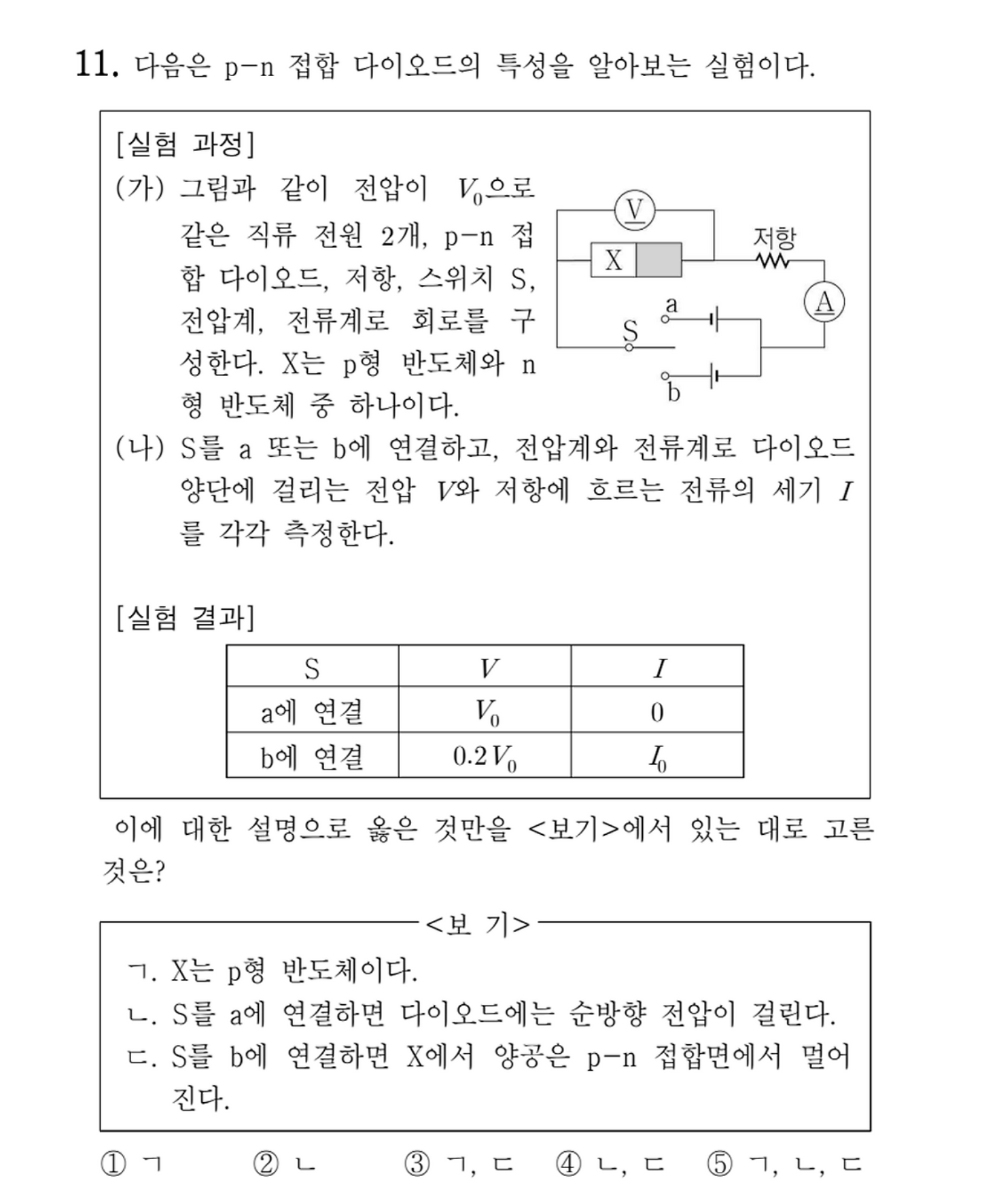
This is an experiment to investigate the characteristics of a p–n junction diode. The experimental procedure and results are as follows. Which of the <STATEMENTS> are correct?
(a) As shown in the figure, the circuit is constructed with two DC power supplies of the same voltage V_0, a p–n junction diode, a resistor, a switch S, a voltmeter, and an ammeter. X is either the p-type semiconductor or the n-type semiconductor.
(b) By connecting S to point a or b, the voltage V across the diode and the current I through the resistor are measured using the voltmeter and ammeter, respectively.
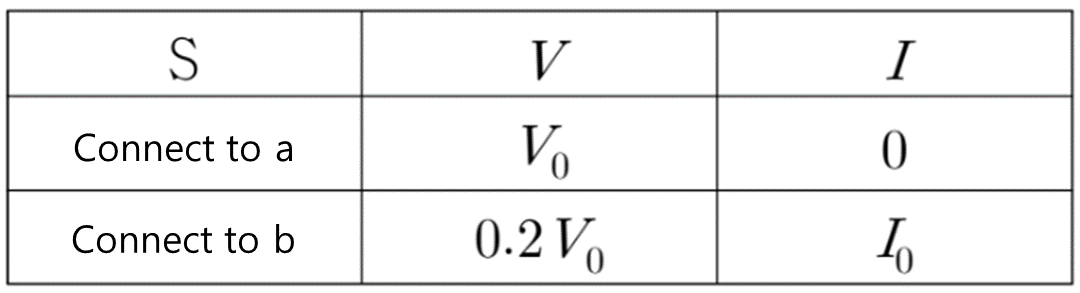
<STATEMENTS>
(a) X is the p-type semiconductor.
(b) When S is connected to a, a forward bias is applied to the diode.
(c) When S is connected to b, the holes in X move away from the p–n junction.
<Answer options>
① a ② b ③ a, c ④ b, c ⑤ a, b, c

[Think Along]
At first glance, the annoying part of this problem is the uncertainty: we don’t know whether X is p-type or n-type.
That said, this problem is actually very simple.
Before solving it, I want to highlight two very useful facts to remember when analyzing electric circuits:
- A voltmeter has infinite resistance.
- An ammeter has zero resistance.
Infinite resistance means that the wire is effectively cut open.
Zero resistance means that it is effectively connected with an ideal wire.
If we apply this knowledge and redraw the circuit, it becomes the following:

The voltmeter has been removed, and the ammeter is replaced by an ideal wire connection.
Now, let’s look at the experimental results.
When the switch was connected to a, no current flowed.
When it was connected to b, current did flow.
Therefore, X must be the p-type semiconductor.
Now, let’s redraw the diagram.

Let’s examine condition (a).
(a) X is the p-type semiconductor.
Correct. We found it just before.
Now, let's see statement (b).
(b) When S is connected to a, a forward bias is applied to the diode.
That is false. When S was connected to a, no current flowed.

How about statement (c)?
(c) When S is connected to b, the holes in X move away from the p–n junction.
That is false. For current to flow, holes and electrons on the opposite side must gather at the junction.
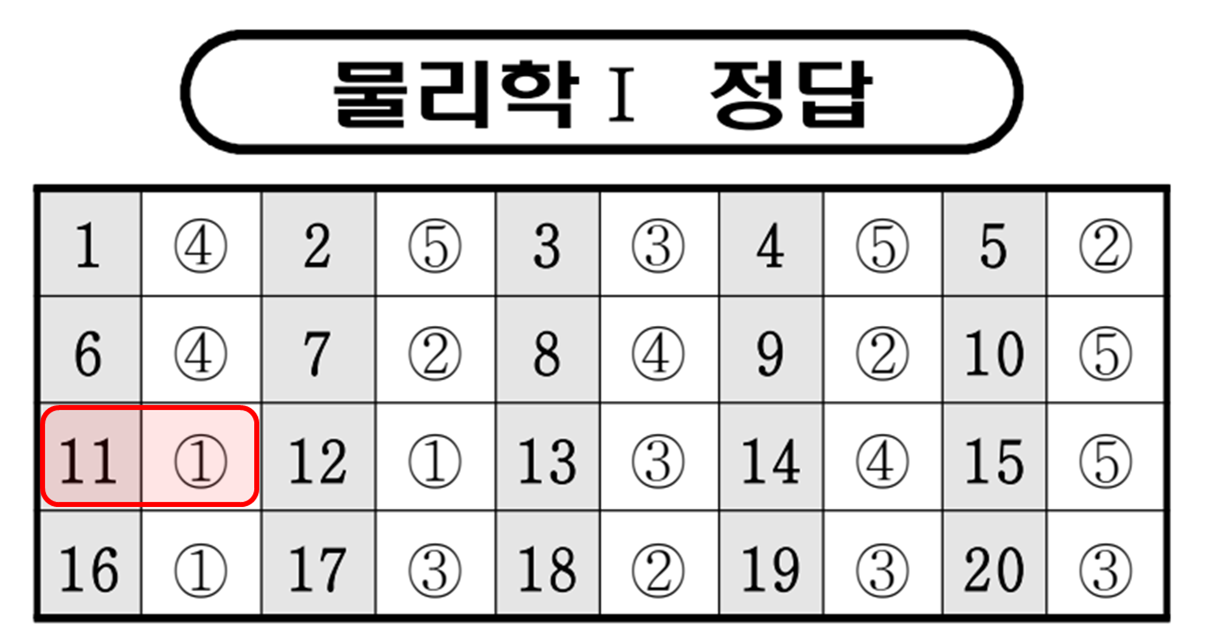
Therefore, the correct answer is ①.
[Original Problem in Korean]
[Translation]
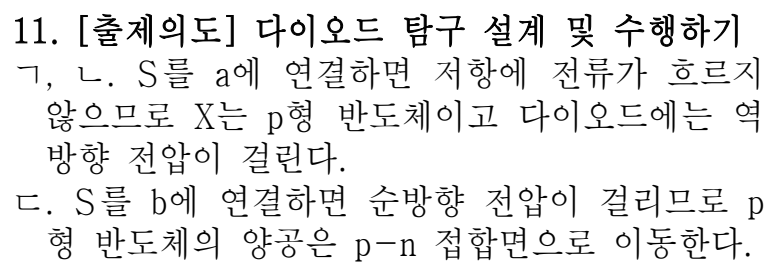
11. [Purpose of the Question] Designing and carrying out diode exploration
a. When S is connected to a, no current flows through the resistor. Therefore, X is a p-type semiconductor and a reverse bias is applied to the diode.
b. When S is connected to b, a forward bias is applied. Thus, the holes in the p-type semiconductor move toward the p–n junction.
[Epilogue]
The solution turned out to be almost disappointingly simple.
Honestly, I expected this problem to be harder.
That’s why, after removing the voltmeter and ammeter from the circuit, I wanted to illustrate how lifting up the horizontal line at the top (the one connecting the diode and the resistor) toward the reader’s face reveals a kind of symmetry in the overall circuit topology (i.e., its connection structure).
If this had been a problem requiring calculation, that symmetry would have allowed us to avoid exploring all four possible cases (switch a/b × semiconductor type p/n). Instead, we could solve just one case and then “recycle” that result to obtain the outcomes for the other three cases essentially for free.
Next time a problem like that appears, I’d like to show how useful symmetry can be in solving electrical circuits.
[Source: July 2025 Korean National Physics I Exam, Grade 12, Problem 11]
'2025 Exams > July' 카테고리의 다른 글
| Just for the sake of a problem kind of problem (1) | 2025.08.23 |
|---|---|
| Taming the Pulley: How to Apply F=ma to Connected Masses (0) | 2025.08.22 |
| The 1, 3, 5, 7 Rule in Uniform Acceleration (0) | 2025.08.22 |
| Sine wave crossing a medium boundary (0) | 2025.08.22 |
| Roads work both ways for Lights (0) | 2025.08.21 |