[SUMMARY]
This blog page intuitively applies the 1-3-5-7 distance rhythm, time-reversal symmetry (‘arrow of time’), and linear scaling to solve a Korean high-school mechanics exam.

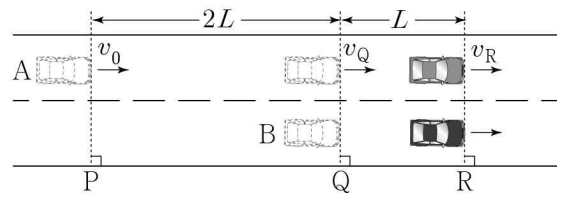
[Problem]
As shown in the figure, when car A passes reference line P with speed v₀, car B, which had been at rest at reference line Q, starts moving. Both A and B undergo uniformly accelerated motion parallel to the straight road and pass reference line R at the same time. When A passes Q and R, its speeds are vQ and vR, respectively. The accelerations of A and B are equal in magnitude but opposite in direction.The distances between P and Q, and between Q and R, are 2L and L, respectively.

[Think Along]
This problem looks really tricky at first.
The annoying part is that there are just too many variables flying around.
But if you flip the perspective, that actually means something nice: there are infinitely many ways to assign values that satisfy the given conditions.
And in every one of those cases, the ratio vQ / vR always comes out to be the same constant.
If that weren’t true, the whole problem would be broken in the first place.
That insight gives us a shortcut: we can freely pick convenient values for the variables and still work out the answer.
After reading the problem a couple of times, it’s not too hard to picture how the two cars must have moved.

Close your eyes and picture this.
A red car is gently pressing the brakes as it passes point P. At that exact moment, a yellow car that had been standing still at point Q starts accelerating, picking up speed as it heads toward point R. By the time the yellow car passes R, the red car—still slowing down—arrives there too. The red car will soon come to a stop, while the yellow one will keep gaining speed and eventually pull ahead.
As the yellow car’s window rolls down, the driver of the red car shouts across: “Hey, it’s a red light!”
To solve this problem intuitively, you need to know two simple tricks:
[Hidden Rhythm in Uniform Acceleration] Uniformly accelerated motion might seem complicated moment by moment, but in fact it follows a very neat and consistent pattern. I like to call it the 1-3-5-7-9 Rule.
Here’s how it works:
- Suppose an object starts from rest.
- If it travels a distance L in the first time interval t,
- then in the next equal interval t, it will travel 3L,
- then 5L in the next,
- then 7L,
- and so on: 9, 11, 13…
This is a beautiful rhythm hidden in every uniformly accelerated motion. Remember it well.

In the diagram, the horizontal axis represents time and the vertical axis represents velocity.
Because this is uniformly accelerated motion, velocity increases in direct proportion to time, so the graph is a straight line.
The red vertical lines mark off equal time intervals of length t. In other words, we’re slicing the motion into equal chunks of time. The blue shapes cut by these red lines represent the distance traveled in each interval—the area under the velocity–time graph.
- In the left diagram, the chosen time interval t is relatively large. The distance in the first interval is equal to the area of 1 triangle. In the second interval, the area equals 3 triangles… so we can clearly see the 1, 3, 5, 7 rule in action.
- In the middle diagram, the interval t is smaller. But even then, the distances still follow the same rule: 1 triangle, 3 triangles, 5 triangles….
- In the right diagram, the triangles look squashed. As you might guess, the slope of each triangle corresponds to the magnitude of acceleration. Even though the acceleration has changed, the distances per interval still obey the 1, 3, 5, 7 rule perfectly.
So much for the 1, 3, 5, 7 pattern. Now, let’s turn to the idea of the arrow of time.
[The Arrow of Time] According to Wikipedia, the “arrow of time” is a concept introduced by the British astrophysicist Arthur Eddington around 1927. Put simply: aside from the Second Law of Thermodynamics (entropy increases), most fundamental laws of physics work the same forward or backward in time—they are time-reversal symmetric.
It’s not something we “prove” in the high-school sense, but for entrance-exam–level problems it’s perfectly fine to treat this idea as true.Now, apply this to uniform acceleration.
Imagine someone fires a cannon straight up at time T₀. The cannonball shoots upward very fast, slows down, comes to rest at the top at time T₁, and then falls back down. Suppose we filmed the motion from T₀ to T₁ and then played the clip in reverse. In the reversed video, the ball starts at rest at T₁, speeds up downward with constant acceleration, and “lands” neatly back in the cannon at T₀.
Crucially, during that reversed playback the motion still obeys the laws of constant acceleration (we’re ignoring air resistance). That’s the arrow of time in action: the equations don’t care whether we run the clock forward or backward.
Now, back to our problem.
We’ll use the Arrow of Time together with the 1-3-5-7 rule of uniform acceleration to crack it quickly and intuitively.
The time it takes for the red car to go from P to R is the same as the time it takes for the yellow car to go from Q to R.
However, the red car travels a distance of 3L, while the yellow car travels L. That lands squarely on the 1 and 3 in the 1–3–5–7 rule. Why is that? I suppose physics teachers know the 1–3–5–7 pattern well. Even back when I took the entrance exam, this pattern was always hidden here and there in physics problems.

The figure places all the information we’ve confirmed so far about the red and yellow cars onto the 1–3–5–7 graph.
The red car was going 4 m/s as it passed P, then went past Q and reached R with a speed of 2 m/s. During that time it traveled 3 m.
The yellow car started from rest at Q, accelerated toward R with 2 m/s², reached 2 m/s at R, and its total travel distance was 1 m.
[Why am I free to choose the speeds?]
Because most problems treated in classical mechanics are linear systems. Roughly speaking, it’s like analyzing a complicated electrical circuit with a 1.5 V battery and finding that the current through some component X is 1 A. If you replace the battery with 15 V, then—without recomputing—the current through X becomes 10 A. That’s the idea. Now, back to the problem.
To get the answer, we need the red car’s speed at Q. On the graph, that means the height of the blue curve at Q. Concretely, we just need to find the point where the ratio of the green hatched area to the yellow hatched area is 1:2. Now it’s a simple math exercise: by mental calculation, Q = √2 .
Remember, the height of the blue graph represents the instantaneous speed.

Now we can compute vQ / vR.
vQ= 2√2 m/s
vR= 2 m/s
So,
vQ/vR = √ 2.
Therefore, the correct answer is choice 2.


[Translation]
18. [Problem Intent] Applying Uniformly Accelerated Motion
If we let the speed of B at point R be v_B, then since the magnitudes of the accelerations of A and B are equal, and the ratio of the distances traveled by A and B is 3:1, we have:
[Source: July 2025 Korean National Physics I Exam, Grade 12, Problem 18]
'2025 Exams > July' 카테고리의 다른 글
| Just for the sake of a problem kind of problem (1) | 2025.08.23 |
|---|---|
| Taming the Pulley: How to Apply F=ma to Connected Masses (0) | 2025.08.22 |
| Simple Tricks for Circuit Simplification (0) | 2025.08.22 |
| Sine wave crossing a medium boundary (0) | 2025.08.22 |
| Roads work both ways for Lights (0) | 2025.08.21 |