[SUMMARY]
This blog page intuitively applies F=ma, system simplification, velocity-continuity, time-ratio reasoning, and acceleration inference to solve a Korean high-school mechanics exam.

[Problem]
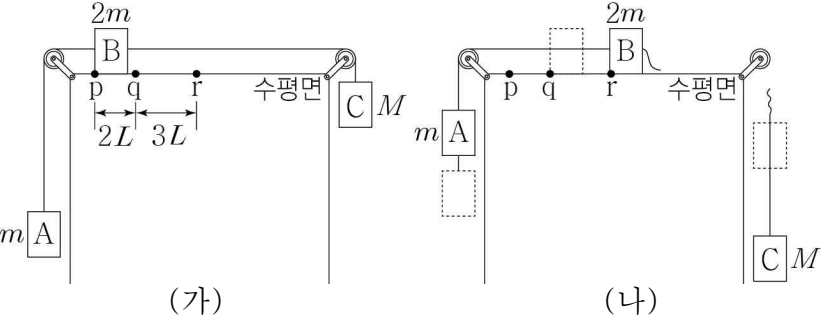
As shown in figure (a), three objects A, B, and C with masses m, 2m, and M, respectively, are connected by strings. When object B is placed at point p and released, A, B, and C move with uniform acceleration.
As shown in figure (b), at the instant B passes point q, the string connecting B and C breaks. After that, A and B continue to move with uniform acceleration, and at point r, the velocity of B becomes zero.
Points p, q, and r lie on a horizontal plane, with the distances pq=2L and .
Find the value of M.
(Assume the objects are point masses, the strings are massless, and all friction and air resistance are negligible.)
[Choices]
① 2m ② 3m ③ 4m ④ 5m ⑤ 6m
[Solution]
This is a problem where multiple masses are connected by a string, and at some point, the string breaks. Most such problems can be solved with the formula F=m. The key is to wisely decide what constitutes the total F and what constitutes the total m, depending on how the objects and strings are connected. Let’s practice with the following diagram.
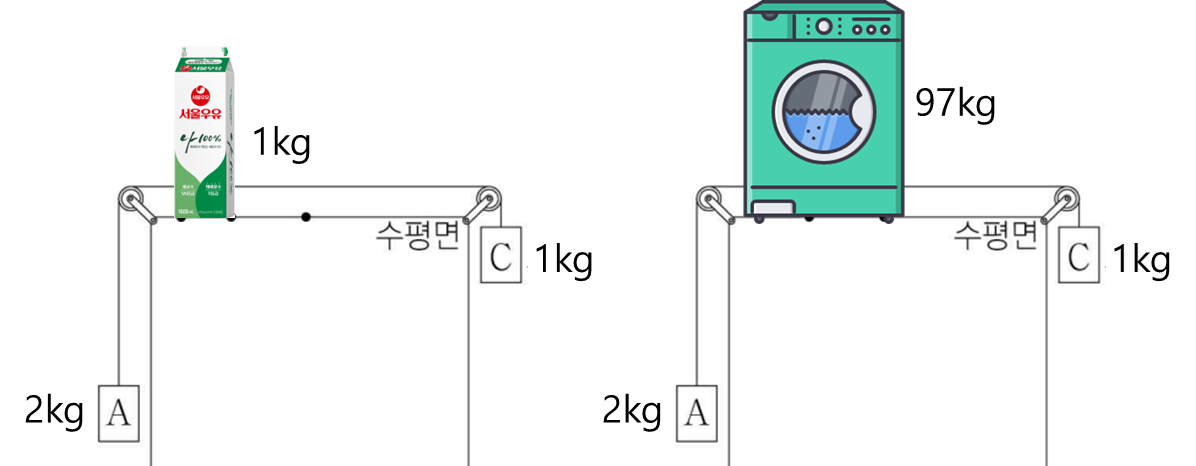
We will apply F=ma to this system.
But before that, let’s test our intuition. In both the left and right diagrams, mass A is heavier than mass C. So, intuitively, A will fall and C will rise. Furthermore, regarding the speed of motion, it somehow feels like the system on the left (with a light milk container hanging) will move faster than the one on the right (with a heavy washing machine attached). That’s an excellent intuition. Still, intuition alone is not enough to solve the problem rigorously. Let’s look at the next diagram.

Compared to the pulley-and-string system from before, doesn’t this new diagram look much simpler? In terms of the horizontal motion of the central mass B (the “milk” or the “washing machine”), this simplified diagram is equivalent to the original one with pulleys and strings. You should be able to feel that the new diagram is far simpler. Now, let’s simplify it even further.

Do you like it better now? Onto this version, we will apply F=ma.

We already knew by intuition that the milk system would accelerate much faster than the washing-machine system, and now we can predict it quantitatively as well.
However, redrawing the setup like this every time isn’t ideal for test-takers. To solve problems within the time limit, you should practice forming F=ma directly from the given diagram, as follows.

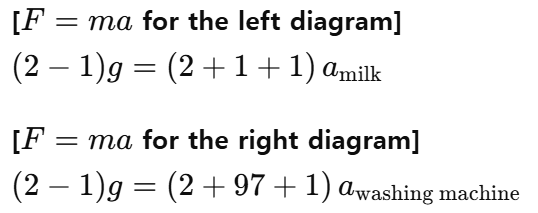
Now that the practice is done, let’s solve the actual problem.
Now it’s time to imagine what happened to A, B, and C.
Figure (a) shows the initial state. With B held firmly at point p, A, B, and C are connected by strings. When the hand is released, the three masses, bound by the strings, will all begin moving together with the same instantaneous velocity. They undergo uniformly accelerated motion—up until the moment B passes point q.
There’s another clue: the fact that B moves from p to q indicates that M is heavier than m.
At the instant B passes point q, however, the string between B and C is cut. From that moment on, B is pulled to the left with a constant acceleration. Thus, its speed gradually decreases until it comes to rest at point . The following diagram shows B’s velocity over time as it passes through points p, q, and r.
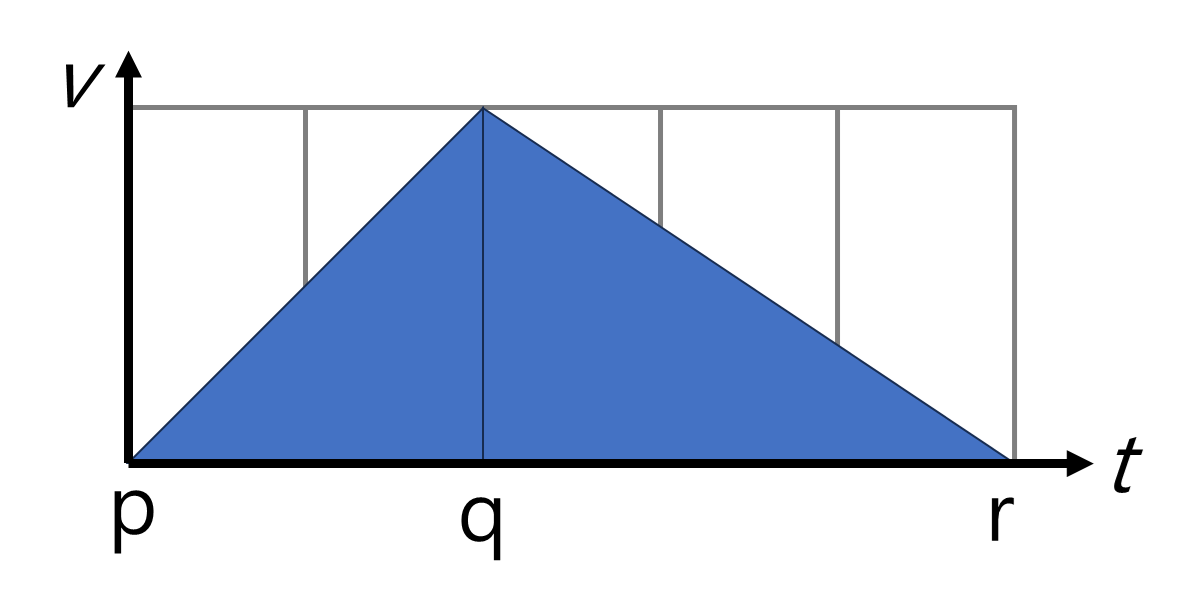
Now let’s look at things from B’s perspective. Initially, B was at rest. Then it moved with uniform acceleration until reaching point q. After that, it experienced uniform acceleration in the negative direction, finally stopping at point r.
But here is an important clue: the distance traveled from p to q is 2L, while from q to r it is 3L—a ratio of 2:3. Doesn’t this raise a question? Why must B’s velocity be continuous at point q?
[Continuity of Velocity]
At first glance, the statement that a body’s velocity must be continuous feels obvious. But if you think carefully, you might wonder—does it really have to be? Intuitively, could an object’s velocity suddenly change? Maybe yes, maybe no...
In fact, Newtonian mechanics gives us a clear answer: no, it cannot. Since F=ma, and as you know, acceleration a is the instantaneous rate of change of velocity v. For v to change abruptly, a would have to become infinite. Because the mass m is fixed, this would mean the force F must also be infinite. But in Newtonian mechanics, an infinite force does not exist.
Therefore, according to Newton’s laws, velocity cannot change instantaneously.
Now, let us put together all the conclusions we have reached so far.
B started from rest at p. While moving to q, it traveled a distance 2L. Its speed at q was v. At the instant the string between B and C snapped, the direction of the net force on B flipped, so B began uniformly accelerated motion in the negative direction. Since the force was not infinite, B’s speed must be continuous at q; therefore, the initial speed for the motion from q to r is also v. By the time B reaches r, its speed becomes zero and it stops. The distance covered during this interval is 3.
Because the area under the speed–time graph equals displacement, to satisfy the condition that the distance from p to q is 2L and from q to r is 3L, the only possibility is that the times for p → q and q → r are in the ratio 2:3 (the slope of the speed–time graph is the acceleration).
Hence, the ratio of accelerations in the two segments is apq:aqr=3:2. This should be enough to solve the problem.
We now apply F=ma to (a) and (b). For convenience, set m=1. (Whether the system is on Earth or the Moon, the ratio between m and M will not change.) Also, M>1.
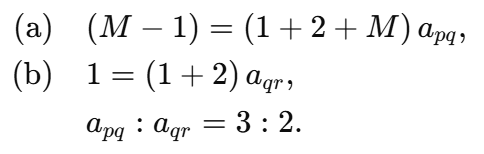
Solving these equations gives the answer:
M=5.
Therefore, the correct choice is ④.

[Translation]
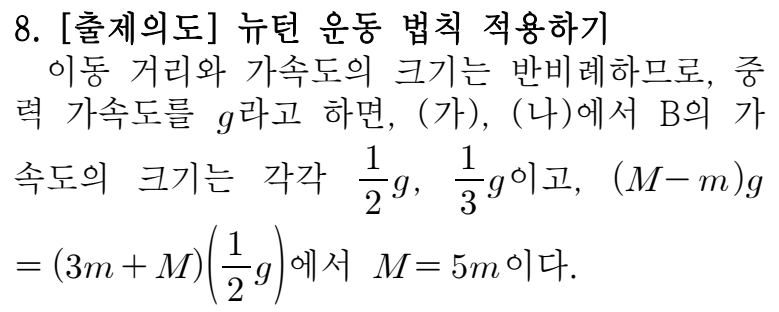
8. [Examiner’s Intent] Applying Newton’s Laws of Motion
Since the travel distance and the magnitude of acceleration are inversely proportional, letting the gravitational acceleration be g, the magnitudes of B’s acceleration in (a) and (b) are 0.5g and 0.333g respectively.

[Source: July 2025 Korean National Physics I Exam, Grade 12, Problem 8]
'2025 Exams > July' 카테고리의 다른 글
| Just for the sake of a problem kind of problem (1) | 2025.08.23 |
|---|---|
| The 1, 3, 5, 7 Rule in Uniform Acceleration (0) | 2025.08.22 |
| Simple Tricks for Circuit Simplification (0) | 2025.08.22 |
| Sine wave crossing a medium boundary (0) | 2025.08.22 |
| Roads work both ways for Lights (0) | 2025.08.21 |