[SUMMARY]
This blog page intuitively uses car-analogy for refractive bending, law of reversibility, medium-density comparison, and a simple geometry trick for critical-angle reasoning to solve a Korean high-school optics exam.
<Original Problem in Korean>
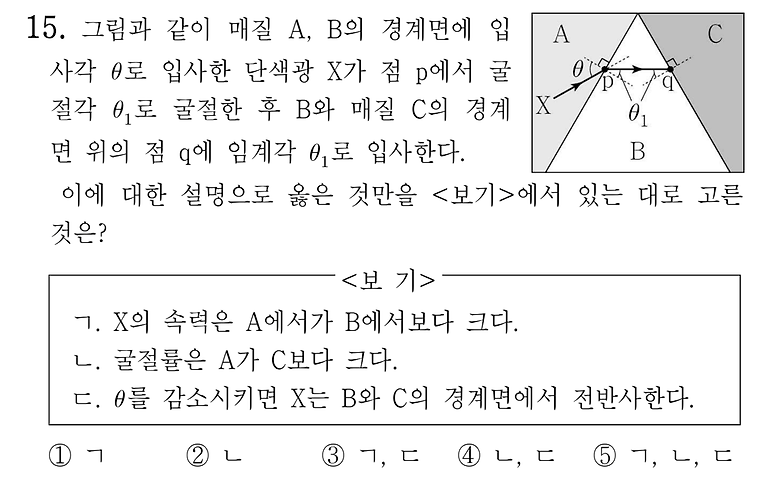
<PROBLEEM>

As shown in the figure, monochromatic light X enters the boundary between media A and B at an angle of incidence θ. It is refracted at point p with an angle of refraction θ₁, and then enters the boundary between medium B and medium C at point q with the critical angle θ₁. Which of the following <STATEMENTS> are correct regarding this situation?
<STATEMENTS>
(a) The speed of X is greater in medium A than in medium B.
(b) The refractive index of medium A is greater than that of medium C.
(c) If θ is decreased, X undergoes total internal reflection at the boundary between media B and C.
<CHOICES>
① a ② b ③ a, c ④ b, c ⑤ a, b, c
[Think Along]
To begin with, let's examine (a).
(a) The speed of X is greater in medium A than in medium B.
From the way the light bends, (a) is true. It’s as if the light is being hindered as it enters from A into B.
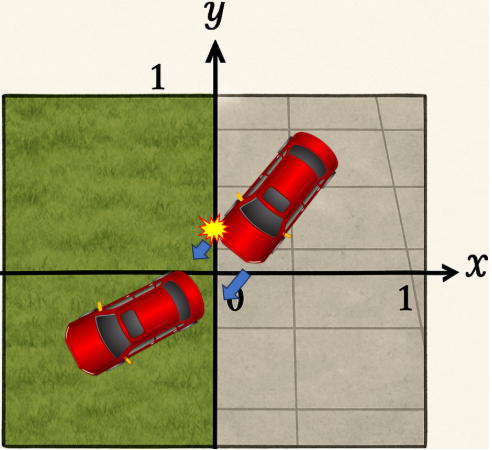
The situation of light entering from a lighter medium (where light travels faster) into a denser medium (slower) can be compared to the following illustration. Imagine a car approaching from roughly the direction (x, y = 1, 1) toward (x, y = 0, 0). As it moves from a smooth cement floor into a grassy field, the car’s right front wheel touches the grass first, while the left wheel is still on the smooth surface. For a brief moment while crossing the boundary, the friction acting on the left and right wheels is different, causing the car to turn slightly to the right. The denser the grass, the more sharply the car will turn.
Enough chit-chat, let’s get back to the problem.
For (b), a small trick is needed.
(b) The refractive index of medium A is greater than that of medium C.
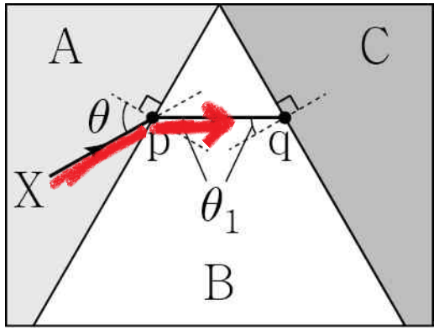
First, just remember one thing: the physical laws of light remain valid even if the direction is reversed. In other words, if light has traveled along a certain path in an optical system, it can also travel along the exact same path in the opposite direction. For example, as shown in the left figure, if the light travels from left to right, then—as in the right figure—it may also travel along the same path in reverse. This principle is extremely useful when solving optics problems, and in geometrical optics it is called the principle of reversibility of light.

Let’s go back to statement (b).
(b) The refractive index of medium A is greater than that of medium C.
In the end, we need to decide which is denser (the “tougher” medium) between A and C.
The bending of the red path when entering from A into B is smaller than the bending of the blue path when entering from C into B. In other words, A < B, and B >> C. If we slightly rearrange the order, it becomes:
B > A
B >>>>> C
Therefore, A >>>> C.
A denser medium has a larger refractive index. Thus, statement (b) is also true.
(To help with understanding, in the right-hand figure I slightly adjusted the incident angle of X′ as it enters from C into B. I was considering the final path of X given in the problem. If light seems to flow along the boundary, can we actually see it? The reason it becomes visible is probably that the interface between the two media is, however slightly, uneven—like the rippling surface of water in a bathtub.)
Finally, let’s move on to condition (c).
(c) If θ is decreased, X undergoes total internal reflection at the boundary between media B and C.
If the angle of incidence θ is reduced, will light X undergo total internal reflection at the B/C boundary?
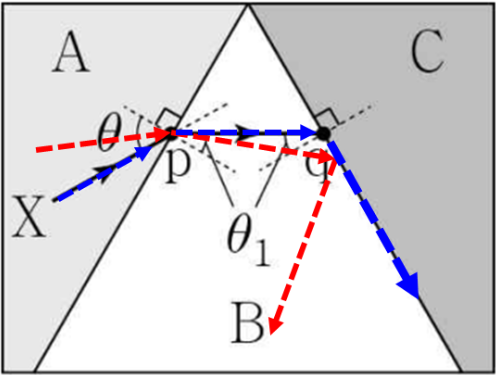
The path of the blue line corresponds to the case when the light enters with an incident angle of θ. As the incident angle becomes smaller, the path of the red line is formed: the direction of travel in medium A is slightly rotated clockwise, and therefore in medium B the light’s direction is also rotated clockwise. As a result, the angle at which it enters toward medium C becomes blunter compared to the original blue path.
If the blue-path light previously traveled along the boundary, then the red-path light—entering at a shallower angle—would either skim along the boundary or fail to cross it, instead bouncing back. Since bouncing back means total internal reflection, statement (c) is also true.
Therefore, since (a), (b), and (c) are all true, the correct answer is choice 5.


[Translated Official Explanation]
15. [Test Designer’s Note] Recognizing Total Internal Reflection and Setting Hypotheses
(a) At point p, since the angle of incidence is larger than the angle of refraction, the speed of X is greater in medium A than in medium B.
(b) At point p, X is refracted with an angle of refraction θ₁, and at point q, X enters with the critical angle θ₁; therefore, the refractive index of A is greater than that of C.
(c) If θ is reduced, then at the boundary between B and C, the angle of incidence becomes larger than the critical angle, resulting in total internal reflection.
[Source: July 2025 Korean National Physics I Exam, Grade 12, Problem 15]
'2025 Exams > July' 카테고리의 다른 글
| Just for the sake of a problem kind of problem (1) | 2025.08.23 |
|---|---|
| Taming the Pulley: How to Apply F=ma to Connected Masses (0) | 2025.08.22 |
| The 1, 3, 5, 7 Rule in Uniform Acceleration (0) | 2025.08.22 |
| Simple Tricks for Circuit Simplification (0) | 2025.08.22 |
| Sine wave crossing a medium boundary (0) | 2025.08.22 |